




The Architect of the Future: An In-Depth Review of Peter Thiel’s Zero to One
Introduction :
In an era dominated by rapid technological iterations, agile frameworks, and copycat SaaS platforms, genuine innovation has paradoxically become rare. Most businesses spend enormous resources competing for incremental gains within pre-existing markets. In Zero to One: Notes on Startups, or How to Build the Future, legendary entrepreneur and venture capitalist Peter Thiel—collaborating with Blake Masters—delivers a philosophical and tactical counter-punch to conventional business wisdom.
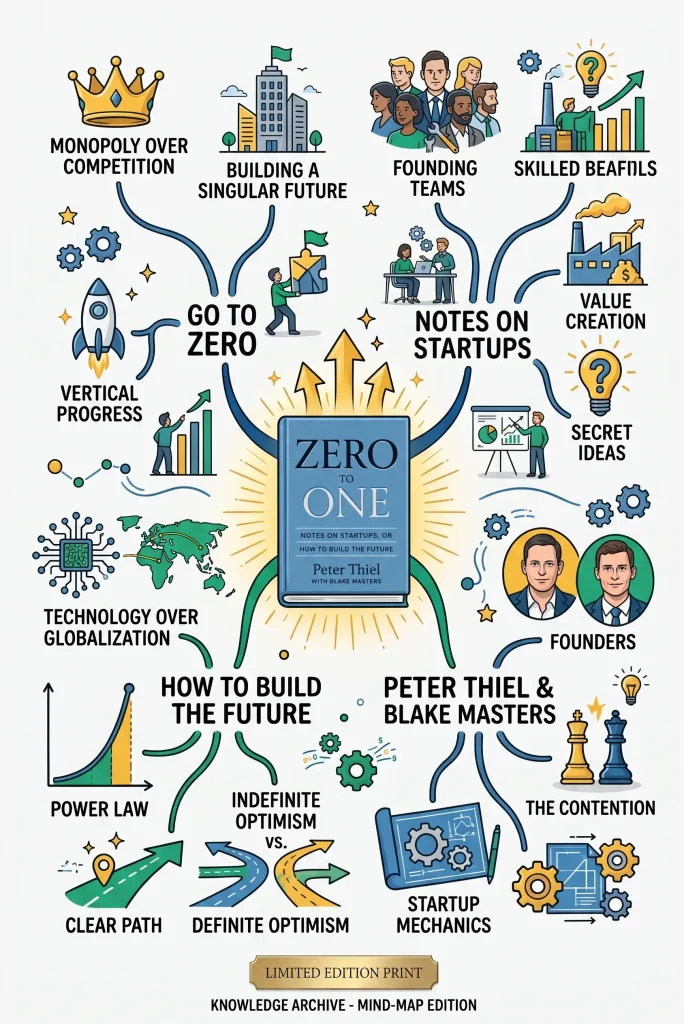
Originally derived from a course on startups taught by Thiel at Stanford University, the book explores a straightforward yet profound premise: every moment in business happens only once. The next Bill Gates will not build an operating system. The next Larry Page will not launch a search engine. If you are copying these pioneers, you are simply taking the world from $1$ to $n$. Real progress comes from going from 0 to 1—creating something entirely unprecedented.
Whether you run an ambitious venture in Silicon Valley, scale an enterprise in Toronto, or launch a fintech solution in the Tech City of London, this book forces you to ask uncomfortable questions about competition, monopoly, and long-term value creation.
Table of Contents
1. The Core Thesis: Progress from 0 to 1 vs. 1 to n
Thiel establishes a critical distinction in the opening pages: horizontal progress versus vertical progress.
- Horizontal progress (Extensive / 1 to n): Taking things that already work and expanding them globally. The archetypal mechanism for horizontal progress is globalization. If you take one typewriter and produce a hundred of them, or manufacture them in another country at lower cost, you are copying existing models.
- Vertical progress (Intensive / 0 to 1): Doing something novel that elevates human capability. The driving vehicle for vertical progress is technology. If you invent a word processor to replace typewriters, you have bridged the divide from zero to one.
                  Vertical Progress (Technology)
                               ▲
                               │     [0 to 1]
                               │  Revolutionary Value
                               │  (PayPal, Google, SpaceX)
                               │
                               │
                               │──────────────► Horizontal Progress
                               0                 (Globalization / 1 to n)
Thiel argues that Western societies have spent recent decades prioritizing globalization over radical technological breakthroughs, settling for incremental digital distractions while ignoring grand frontiers like clean energy, biotechnology, and infrastructure. To dive deeper into empirical analyses of economic growth and long-term productivity stagnation, examine the research produced by the National Bureau of Economic Research (NBER) and the Federal Reserve Bank of San Francisco.
2. The Contrarian Question and Intellectual Independence
The intellectual anchor of Zero to One rests on a question Thiel routinely asks candidates in interviews:
“What important truth do very few people agree with you on?”
This inquiry is not an exercise in provocation or quirky contrarianism; it is a diagnostic tool for intellectual rigor. A sound contrarian answer identifies a hidden reality that consensus thinking systematically overlooks.
Thiel observes that business orthodoxy is driven by social mimicry. Founders frequently mistake popular consensus for strategic insight. True breakthroughs occur at the intersection where private knowledge diverges from public convention. For an analytical breakdown of market psychology and herd behavior in finance, read the institutional perspectives provided by the Harvard Business School Working Knowledge platform.
3. Why Competition is for Losers: The Power of Creative Monopolies
Perhaps the most controversial assertion in Zero to One is Thiel’s unabashed endorsement of monopolies.
Traditional economic textbooks praise perfect competition as the pinnacle of market efficiency. In competitive equilibrium, however, all profits are eroded by market forces, leaving firms to engage in a desperate race to the bottom on price and operational margins. Thiel argues that creative monopolies—firms that innovate so radically that no direct substitute exists—generate durable value both for their founders and for society at large.
+-----------------------------------+-----------------------------------+
|       Perfect Competition         |        Creative Monopoly          |
+-----------------------------------+-----------------------------------+
| * Undifferentiated commodities    | * Proprietary technology (>10x)   |
| * Zero long-term economic profit  | * Massive sustained cash flows    |
| * Focus on daily survival/margins | * Capital reinvestment in R&D     |
| * Disguise competition as unique  | * Disguise dominance as competitive|
+-----------------------------------+-----------------------------------+
A creative monopoly earns supracompetitive returns because it solves an acute problem significantly better than existing alternatives. These sustainable cash flows allow the firm to invest in moonshot research, retain world-class talent, and shape the future without fear of immediate margin collapse.
For readers tracking regulatory enforcement and antitrust law across the United States, United Kingdom, and Canada, consult statutory analyses from the Federal Trade Commission (FTC) alongside enforcement guidelines published by the UK Competition and Markets Authority (CMA).
4. The Anatomy of Monopoly: Four Core Characteristics
Thiel breaks down the defensible competitive advantages that allow a zero-to-one venture to preserve its monopoly status over decades:
Proprietary Technology
Your core technology must be at least ten times (10x) better than its closest substitute in a meaningful dimension. A 10% or 20% improvement is easily absorbed or copied by incumbents. An order-of-magnitude leap (such as Google’s PageRank algorithm over early 1990s directory search engines, or Amazon offering millions of books online versus a brick-and-mortar storefront) renders competition obsolete.
Network Effects
Network effects occur when a product becomes inherently more valuable as more people use it. Thiel cautions that network effects are impossible to capture unless your initial product offers extreme standalone utility to a tiny subset of users. Facebook started exclusively at Harvard before expanding across universities and eventually to global scale.
Economies of Scale
A software or digital product features negligible marginal cost to reproduce, allowing unit economics to strengthen dramatically as volume expands. Building massive fixed investments that scale cleanly into recurring revenue is critical to long-term defensibility.
Branding
Brand equity is powerful, but Thiel warns against treating branding as a substitute for substance. Apple’s brand carries authority because it is backed by world-class hardware architecture, proprietary chip design, and vertically integrated operating systems. Copying the aesthetic of a successful brand without the underlying proprietary advantage is a recipe for failure.
5. The Power Law: The Hidden Math of Venture Capital and Careers
One of the most consequential chapters in Zero to One explores the distribution of returns governed by the Power Law (the Pareto Principle on steroids).
In venture capital portfolios, investment returns do not follow a standard bell curve. The best investment in a successful fund routinely yields returns greater than or equal to all other investments combined. The second-best investment out-earns everything else below it.
Portfolio Return Distribution:
1 Venture Winner  ████████████████████████████████████████████  (> 75% of fund profits)
2nd Place         ████████                                      (~ 15% of profits)
Remaining 30 Cos  ██                                            (Remaining total / write-offs)
Thiel explains that this mathematical reality extends far beyond venture investing:
- Life Choices: You cannot diversify your life. You cannot run twenty careers simultaneously. The Power Law dictates that one single decision or skill set will dominate your professional output.
- Distribution Channels: In sales and marketing, one distribution channel typically accounts for the overwhelming majority of your customer acquisition. Companies that master a single primary acquisition loop flourish, while those spreading efforts across dozens of mediocre funnels stagnate.
For in-depth analysis of mathematical distributions in venture performance, explore institutional research papers hosted by the Stanford Graduate School of Business.
6. Secrets, Mechanics, and Founding Teams
Startups are fundamentally built on uncovering hidden truths—what Thiel labels “Secrets”:
- Secrets of Nature: Unsolved physics, chemistry, or biological frontiers that wait to be discovered.
- Secrets About People: Blind spots in social psychology, economic incentives, or institutional inertia.
Discovering a valuable secret gives a founder a massive unfair advantage. To execute upon that secret, however, founders must design cohesive organizational mechanics. Thiel highlights the hazards of misaligned incentives:
- Ownership: Who formally controls equity in the company (Founders, Investors)?
- Possession: Who actually operates and directs daily work (Employees, Managers)?
- Control: Who oversees the firm’s fiduciary direction (Board of Directors)?
Misalignments between these three tiers cause internal dysfunction that can destroy promising startups long before competitive external pressures ever reach them. Thiel’s rule on executive compensation is equally blunt: lower CEO cash compensation correlates with higher venture success, as high equity stakes force leadership to prioritize enterprise equity over short-term personal liquidity.
7. Comparative Perspective: North American & UK Business Landscapes
The framework of Zero to One remains directly applicable to founders across diverse modern entrepreneurial ecosystems:
- United States: Silicon Valley, Austin, and New York frequently wrestle with inflated valuations and hype cycles. Thiel’s framework serves as a grounded checklist for evaluating whether a venture possesses durable moat characteristics or is simply riding market noise.
- United Kingdom: Founders operating in London, Cambridge, and Oxford often excel at deep-tech, artificial intelligence, and life sciences research. Zero to One offers an actionable roadmap for transitioning academic breakthroughs into commercial, defensible monopolies rather than licensing intellectual property away cheaply to multinational conglomerates.
- Canada: Innovation clusters in Toronto-Waterloo, Montreal, and Vancouver benefit from top-tier engineering talent and immigration pathways. Thiel’s thesis provides Canadian entrepreneurs with the strategic conviction needed to scale independently into global category leaders rather than selling prematurely to foreign acquirers.
8. Summary Table of Key Contrasts
| Dimension | The Consensus / Crowd | Peter Thiel’s View (Zero to One)
|
| — | — | — |
| Progress | Globalization ($1 \to n$)
| Technological breakthrough ($0 \to 1$)
|
| Market Structure | Perfect competition is ideal
| Creative monopoly is the prerequisite for enduring value
|
| Strategy | Iterate, stay agile, pivot frequently | Definite optimism: build a singular, long-term plan
|
| Market Entry | Target huge multi-billion dollar markets | Dominate a tiny, well-defined niche first |
| Distribution | Focus solely on product; it will sell itself | Distribution is vital; superior sales beats superior product |
9. Final Verdict
Zero to One is neither a generic self-help book nor a dry academic textbook on microeconomics. It is a sharp, lucid, and unapologetic manifesto on entrepreneurial creation. Peter Thiel challenges builders, executives, and innovators to stop copying surface-level templates and instead construct companies that permanently alter the course of human capability.
For entrepreneurs, technology leaders, and business students across the US, UK, and Canada, this volume remains an indispensable foundational text.

Download the E-Book Edition
Equip your digital library with the insights that shaped modern Silicon Valley strategy.
👉 Download the Official Zero to One by Peter Thiel E-Book (PDF & EPUB)

Previous Post