


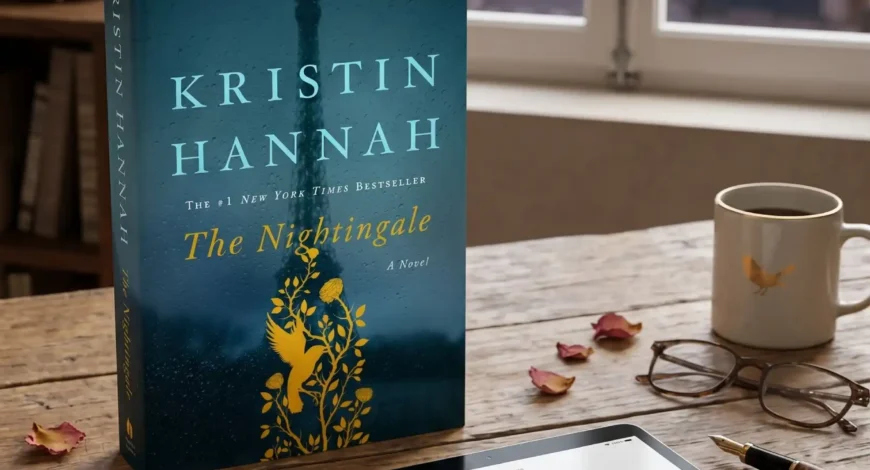
The Nightingale by Kristin Hannah: The Definitive Review, Historical Analysis, and Reader’s Guide
Introduction :
Few works of historical fiction have captured the hearts and minds of international readers quite like The Nightingale by Kristin Hannah. Since its publication, this monumental novel has spent countless months atop the New York Times and Sunday Times bestseller lists, garnering praise from critics, book clubs, and everyday readers across the United States, the United Kingdom, and beyond.
If you have ever asked yourself what ordinary people are capable of when pushed to the absolute brink, this book delivers an uncompromising, emotionally shattering answer.
In this comprehensive review and literary guide, we unpack the historical inspirations behind the narrative, examine its unforgettable characters, explore the central thematic questions, and explain why this wartime epic remains an absolute must-read.
Table of Contents
Looking to start reading right away?
You can download the complete digital edition in both PDF and reflowable EPUB format directly from our store:
➔ Get The Nightingale by Kristin Hannah eBook at Digital Haven Books
1. Executive Summary & Book Overview
- Title: The Nightingale
- Author: Kristin Hannah
- Genre: Historical Fiction / WWII Drama / Women’s Fiction
- Primary Setting: German-Occupied France (Paris, Carriveau, the Pyrenees Mountains)
- Time Period: 1939–1945 (with framing scenes in 1995)
- Key Themes: Female heroism, the silent home front, moral compromise, sisterhood, survival, and grief
- Target Audience: Fans of Anthony Doerr’s All the Light We Cannot See, Heather Morris’s The Tattooist of Auschwitz, and Ken Follett’s The Century Trilogy.
The Core Premise
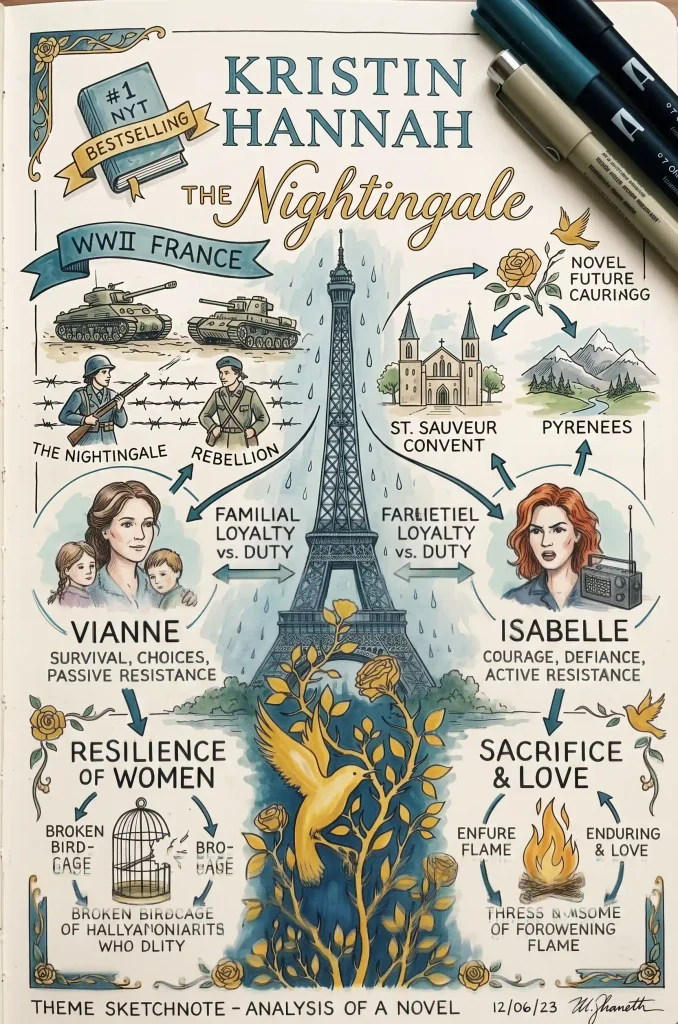
The story is told through the alternating viewpoints of two estranged sisters living in France during the dawn and escalation of World War II:
- Vianne Mauriac: The elder, traditional sister. Living in the quiet Loire Valley village of Carriveau with her young daughter, Sophie, Vianne must navigate life after her husband, Antoine, is called up to the frontline. When the village falls under German occupation, an enemy officer billets inside her home, forcing Vianne into impossible ethical and practical dilemmas to keep her child fed and alive.
- Isabelle Rossignol: The younger, fierce, and defiant sibling. Repeatedly expelled from boarding schools and abandoned emotionally by their traumatized father, Isabelle arrives in Carriveau burning with anger at the capitulation of France. Unable to abide complacency, she joins the French Resistance, adopting the code name “The Nightingale” and shepherding shot-down Allied airmen across the snow-capped Pyrenees into neutral Spain.
Through these polar-opposite lives, Kristin Hannah explores the duality of war: the bombastic violence fought on battlefields and the quiet, agonizing war fought inside living rooms, pantries, and covert mountain passes.
2. In-Depth Character Analysis: Two Faces of Resistance
A primary reason why The Nightingale resonates so deeply with modern book clubs lies in its refusal to offer simplistic caricatures of courage.
┌───────────────────────────────────────────────┐
│ THE SPECTRUM OF RESISTANCE │
└───────────────────────────────────────────────┘
│
┌───────────────────────┴───────────────────────┐
▼ ▼
[ ISABELLE ROSSIGNOL ] [ VIANNE MAURIAC ]
• Active, militant defiance • Quiet, protective endurance
• “The Nightingale” code name • Clandestine rescue of children
• Escorting downed Allied aviators • Enduring billeting & starvation
• Audacity, rage, physical risk • Moral complexity & maternal instinct
Isabelle Rossignol: The Flame of Open Rebellion
Isabelle embodies the romantic, fierce, and fearless archetype of resistance. From the moment the German army marches down the Champs-Élysées, her instinct is direct action. Rather than accepting defeat, she risks torture and execution to establish an escape line for British and American airmen.
Isabelle’s character was heavily inspired by real-life heroine Andrée de Jongh, a Belgian woman who created the famous Comet Line (Réseau Comète). Like de Jongh, Isabelle treks through freezing blizzards across the Franco-Spanish border, risking Gestapo capture at every railway checkpoint.
Her journey is one of maturation: transforming raw, petulant anger into organized, selfless courage.
Vianne Mauriac: The Silent Front and the Burden of Compromise
While Isabelle’s bravery is thrilling and cinematic, Vianne’s story often cuts deeper into the marrow of daily human suffering. Vianne is not a soldier; she is a mother. Her battleground is the dining table where German Captain Beck sits; her weapons are silence, misdirection, and paperwork.
When the anti-Jewish decrees strip her childhood best friend, Rachel de Champlain, of citizenship and dignity, Vianne is forced to confront the complicity of silence. Her evolution from a frightened homemaker to a clandestine savior—forging papers and hiding Jewish children in a local Catholic orphanage run by Mother Superior—is one of the most poignant character arcs in recent literature.
Hannah challenges the reader: Would you have thrown a grenade, or would you have kept your head down to protect your daughter’s life?
3. Key Themes Explored
Women’s Unsung Wartime Contributions
Historical accounts of the Second World War have traditionally centered on battlefield commanders, tank battalions, and political leaders. Hannah consciously flips the lens. As she poignantly writes in the author’s note, men march off to war, receive medals, and write memoirs, while women are left behind to keep society standing in the ruins.
The Nightingale restores the female voice to historical memory, spotlighting:
- The danger of food rationing and starvation.
- The emotional and physical toll of enemy requisitioning.
- The critical logistical roles women played as couriers, radio operators, and safe-house keepers in networks coordinated by entities like the British Special Operations Executive (SOE).
The Ambiguity of Survival and Moral Cost
Unlike classic action thrillers where good and evil are separated by clear lines, Hannah paints wartime occupation with realistic moral ambiguity.
Captain Beck, the German officer billeted at Vianne’s home, is not a rabid zealot. He is polite, cultured, and fond of classical music, often displaying genuine kindness toward Vianne’s daughter. Yet, he wears the uniform of an empire that rounds up families for extermination.
Hannah forces the reader to confront uncomfortable realities:
- How close can one stand to evil without becoming tainted by it?
- What compromises can a human soul make in exchange for food and shelter before losing its moral identity?
The Complex Bonds of Sisterhood
Underneath the geopolitical drama is a heart-rending domestic family saga. Vianne and Isabelle have spent years carrying deep wounds from their mother’s early death and their father’s post-traumatic withdrawal following the Great War.
Throughout the narrative, their paths diverge and intersect, testing their fragile alliance. Their ultimate reconciliation is built not on words, but on shared sacrifices that redefine their understanding of love and loyalty.
4. Historical Context: Fiction Grounded in Real Valor
To truly appreciate Kristin Hannah’s craftsmanship, one must understand the real-world historical framework underpinning the novel.
The Fall of France and the Vichy Regime (1940)
In June 1940, the French government surrendered to Nazi Germany, resulting in the partition of the country into an occupied northern zone and the collaborationist Vichy regime in the south. The novel accurately conveys the panic of the Exode—the mass flight of millions of civilians fleeing southward under aerial bombardment. Readers interested in historical records of this period can consult resources provided by the Imperial War Museums.
The Comet Line and Escaper Networks
The most electrifying portions of Isabelle’s narrative stem from actual operations conducted by European resistance fighters. Between 1941 and 1944, secret evasion networks safely transported over 3,000 Allied airmen back to the United Kingdom. These operations involved:
- Fake identification cards and ration books forged in basements.
- Covert medical treatment for wounded pilots hidden in attics.
- Grueling 16-hour foot crossings over the snow-bound Basque Pyrenees into San Sebastián.
For authoritative documentation on these escape corridors, see the historical archives maintained by the Royal Air Force Museum.
The Holocaust in France and the Rescue of Children
Hannah handles the persecution of France’s Jewish population with sobering historical accuracy. From the yellow star decrees to the infamous Vélodrome d’Hiver Roundup of July 1942, the novel depicts how regular French citizens reacted—some collaborating for reward, others risking public execution to conceal children in convents and boarding schools. Vianne’s fictional rescue effort pays homage to real Righteous Among the Nations figures who hid more than 10,000 children across rural France.
5. Kristin Hannah’s Writing Style and Literary Craft
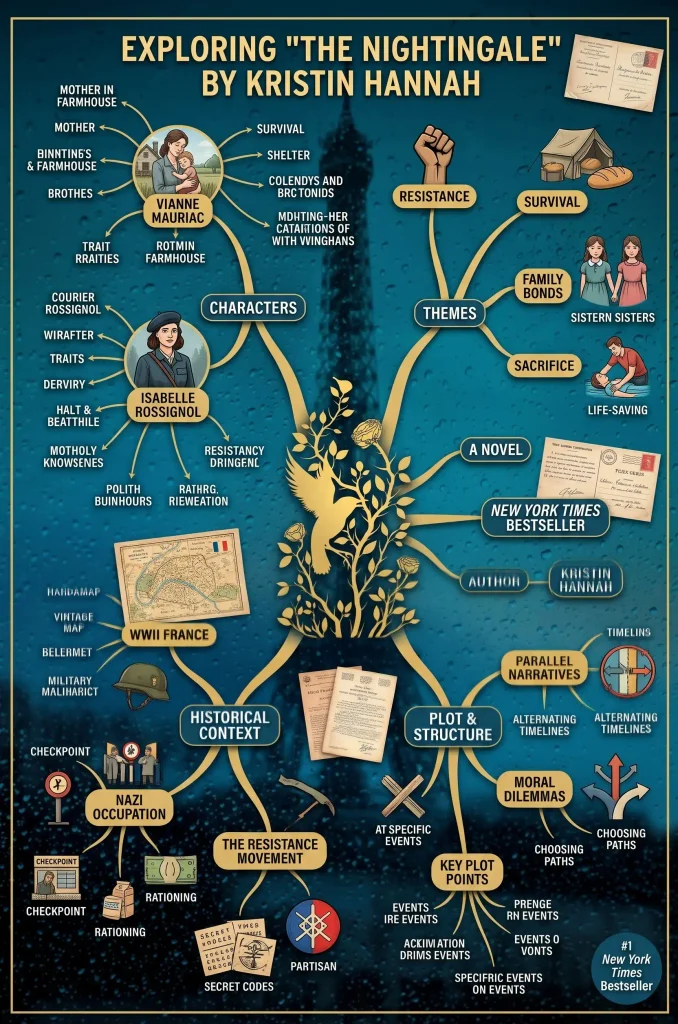
Hannah’s prose is accessible, highly visual, and paced with deliberate emotional momentum. She excels at several specific craft techniques:
| Literary Element | Execution in The Nightingale | Reader Impact |
| Pacing | Alternates between slow-burn dread (Vianne) and fast-paced covert thriller (Isabelle). | Prevents reader fatigue while sustaining high stakes throughout 440+ pages. |
| Sensory Detail | Meticulous descriptions of physical cold, the metallic smell of stale rationed chicory, and the damp air of Paris cellars. | Total immersion in the grinding physical deprivation of occupied Europe. |
| Dual Narrative Frame | An elderly narrator looking back in 1995 whose specific identity is intentionally withheld until the climax. | Adds an ongoing mystery that compels readers forward to piece together who survived. |
6. What Critics and Readers Are Saying
The book has achieved widespread acclaim across literary institutions and user-generated review platforms like Goodreads and StoryGraph:
- The Washington Post: “An ambitious, beautifully written novel that celebrates the resilience of the human spirit.”
- Goodreads Community (Over 1.5 Million Ratings): Maintained an astounding 4.6 / 5.0 rating, winning the Goodreads Choice Award for Best Historical Fiction.
- Book Club Consensus: Frequently selected by community reading groups across North America and the UK due to its fertile discussion topics around ethics, parenting during crisis, and historical memory.
7. Comparative Reading: Where Does It Stand?
If you enjoy 20th-century historical literature, The Nightingale stands beside several modern classics:
- All the Light We Cannot See by Anthony Doerr: While Doerr focuses on poetic, lyrical imagery, non-linear timelines, and the marvels of radio technology, Hannah’s style is more character-driven, visceral, and emotionally direct.
- The Alice Network by Kate Quinn: Quinn highlights World War I female espionage networks with a brassier, cynical tone, whereas Hannah maintains an intimate, poignant meditation on civilian endurance and family trauma.
- The Book Thief by Markus Zusak: Zusak approaches wartime tragedy through whimsical personification (Death as narrator), while Hannah keeps her narrative grounded in historical realism and emotional verisimilitude.
8. Why You Should Read It Today (And Where to Get It)
In times of uncertainty, stories that explore resilience, dignity, and quiet acts of conscience become vital reading. The Nightingale is not merely an entertaining escape; it is a masterclass in empathy and a poignant tribute to women whose bravery history neglected to record.
Whether you are preparing for a local book club discussion, researching wartime resistance networks, or searching for an unputdownable story for your weekend reading list, this book belongs on your shelf.
Read It on Any Device
You can secure your copy immediately in universal digital formats suitable for Apple Books, Amazon Kindle, Kobo, Android tablets, or your desktop computer:
➔ Download The Nightingale by Kristin Hannah (PDF & EPUB Bundle) at Digital Haven Books
What you receive:
- Clean, high-resolution EPUB: Formatted for easy font customization and nighttime reading mode on mobile e-readers.
- Universal PDF: Preserves original typographic layouts, ideal for tablet and desktop reading.
- Instant Delivery: Download link delivered to your screen and inbox immediately upon purchase.
9. Book Club Discussion Questions
Planning to read The Nightingale with your group? Here are five thought-provoking questions to spark debate:
- The Nature of Courage: Did Vianne or Isabelle demonstrate greater courage? Can one form of resistance be considered “superior” to the other?
- The Morality of Captain Beck: How did you perceive Captain Beck’s character? Does his personal politeness excuse his active participation in an occupying military force?
- The Power of Identity: Why was the code name “The Nightingale” so fitting for Isabelle? How did the pseudonym protect her psychologically during her missions?
- Paternal Grief: How did their father Julien’s traumatic experiences in World War I shape his strained relationship with his daughters? Did his final acts redeem his past neglect?
- The Mystery Framing: At what point in the novel did you discover the true identity of the elderly narrator in the 1995 chapters? Did that realization alter your interpretation of earlier scenes?
Ready to read The Women?
An in-depth review and literary analysis of The Nightingale by Kristin Hannah. Explore its characters, historical context, and enduring impact.
GET The Nightingale E-BOOK HERE
Previous Post
The Women by Kristin Hannah Review:

Next Post