



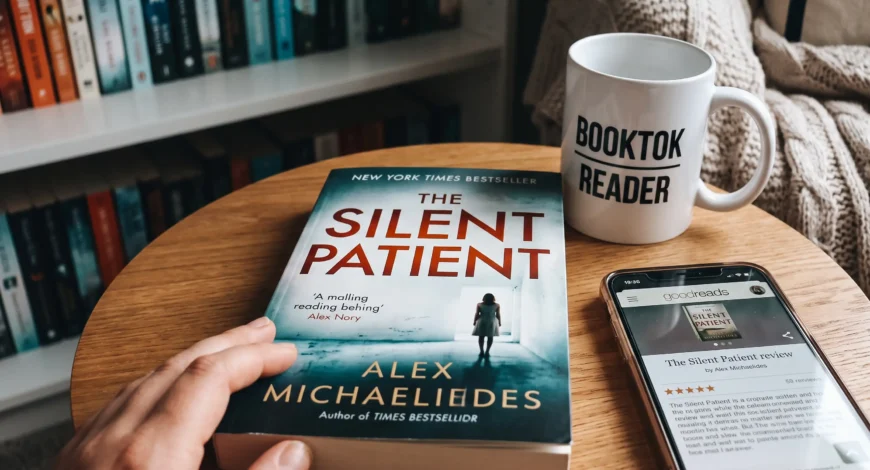
The Silent Patient Review: Why Alicia Berenson’s Chilling Silence Still Haunts Us
Introduction
There is an old, unsettling proverb about silence being golden, but in modern crime fiction, silence is rarely an act of peace. More often, it is a deliberate, violent refusal to confess. When I first sat down to write this The Silent Patient review, I kept returning to a single, nagging question: what drives an otherwise rational human being to murder the person they love most, paint a single portrait, and then shut the door on language entirely?
Alex Michaelides did not just write a breakout debut when he released this book in 2019; he tapped into an ancient, primal nerve. Long before it dominated aesthetic short-form videos across BookTok, the premise was already whispering in the ears of thriller purists. On the surface, it masquerades as a typical British domestic noir, but as you peel back the layers, you realize you are dealing with something far more clinical, tragic, and intensely claustropho
The Crime, The Canvas, and The Complete Refusal to Speak
The tragedy that sets the entire narrative in motion occurs on a hot summer evening in a wealthy corner of Northwest London. Alicia Berenson—a gifted, emotionally complex painter—is married to Gabriel, a glamorous and sought-after fashion photographer. By all outward accounts, their life together is an enviable picture of modern bohemian luxury: a grand Victorian townhouse with tall sash windows overlooking the leafy serenity of Hampstead Heath, private gallery openings, and intellectual dinner parties.
Then, the picture shatters.
Gabriel comes home late from a studio shoot. Half an hour later, neighbors report hearing gunshots echoing into the night street. When the police breach the house, they find a scene straight out of a clinical nightmare: Gabriel is tied to a dining chair, shot five times point-blank in the face. Alicia is standing quietly beside his corpse, a utility knife nearby, her wrists slashed, bleeding out onto the floorboards.
She survives the emergency surgery, but her voice does not. From that violent hour forward, Alicia Berenson never utters another syllable. Not during her arrest, not throughout her sensational trial, and not when she is locked away indefinitely inside The Grove—a faded, secure forensic psychiatric unit in North London.
Her only commentary on the slaughter of her husband is an arresting, enigmatic self-portrait finished while she was under house arrest in the days immediately following the crime. In the bottom left corner, she scrawls a single word in Greek: Alcestis.
Enter Theo Faber: Ambition Masked as Compassion
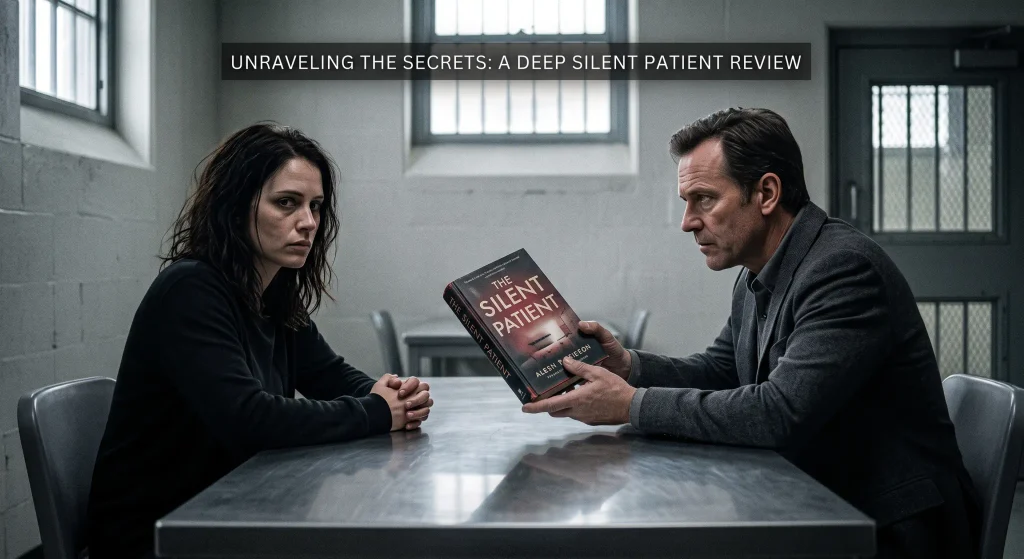
Every memorable mystery requires an investigator who is just as bruised as the suspect, and this is where Michaelides introduces Theo Faber. A seasoned forensic psychotherapist, Theo has spent years obsessing over Alicia’s case from afar. When a clinical post unexpectedly opens up at The Grove, he leaps at the opportunity, leaving a prestigious hospital behind to take a gamble on a facility that is bleeding public funding.
Theo’s declared motivation is noble on paper: he genuinely believes that conventional pharmacological treatments are numbing Alicia into a vegetative state, and that through patience, psychoanalytic holding, and deep empathy, he can unlock the psychological lockbox she has built around herself. He wants to help her find her voice again.
Yet, as any honest The Silent Patient review must acknowledge, Theo is profoundly compromised from the start. He is battling an unraveling marriage with his free-spirited American wife, Kathy, a trauma-riddled childhood characterized by an abusive father, and a persistent habit of crossing professional boundaries in the name of “therapy.” As Theo conducts off-the-record investigations into Alicia’s past—interviewing her slippery art dealer, her resentful brother-in-law, and an aloof childhood friend—the reader begins to feel an uneasy shift: Theo is no longer just treating a patient; he is seeking his own psychological redemption through her.
The Narrative Engine: Diary Entries and Clinical Dread

The book’s structural pacing is what keeps readers turning pages deep past midnight. Michaelides structures the narrative around two alternating, contrasting engines:
- Theo’s Present-Day First-Person Voice: Analytical, self-reflective, and steadily descending into erratic, obsessive behavior as the administrative walls of The Grove close in around him.
- Alicia’s Lost Diary Entries: Written in the weeks leading up to the murder, these passages capture an intimate portrait of a woman spiraling into severe paranoia, convinced a shadowy figure is stalking her around her home while her husband dismisses her fears as creative burnout.
This structural back-and-forth generates an agonizing sense of dramatic irony. You are constantly reading Alicia’s private words while watching Theo attempt to extract those very same emotions from a woman sitting across from him in an interrogation-style therapy room, slack-jawed, heavily medicated, and utterly unresponsive.
For readers who appreciate this style of layered, unreliable narration and high-stakes domestic manipulation, checking out our deep dive into None of This Is True by Lisa Jewell reveals a striking thematic parallel—especially in how modern authors weaponize personal records like private journals and true-crime podcasts to blur the line between victim and perpetrator.
The Mythological Underpinning: Why Alcestis Matters
One aspect that is often overlooked in a rushed, surface-level The Silent Patient review is the novel’s sophisticated literary architecture. Michaelides studied English literature at Cambridge and Greek drama, and that classical background deeply enriches the plot.
The ancient Greek play Alcestis, written by Euripides and documented extensively on Encyclopædia Britannica, serves as the symbolic foundation for Alicia’s condition:
- In the ancient tragedy, King Admetus is spared from death by the gods on one condition: someone must willingly die in his place.
- While his parents refuse, his loyal wife, Alcestis, steps forward to sacrifice her life.
- The hero Heracles eventually journeys down to Hades, wrestles Death, and brings Alcestis back to her husband.
- Crucially, when she returns to the mortal realm, Alcestis remains utterly mute. She refuses to speak to the man who allowed her to perish in his stead.
By naming her final canvas after this myth, Alicia isn’t offering an artistic afterthought; she is leaving an indictment in plain view. The genius of the story is how it forces the reader to confront an uneasy possibility: was Gabriel truly the blameless, loving partner everyone claimed he was, or had he demanded a silent emotional sacrifice long before that fatal summer night?
Breaking Down the Mechanics
| Narrative Element | Execution & Impact |
| Pacing | Rapid-fire, short chapters designed for compulsive, late-night reading. |
| Atmosphere | Dreary, autumnal London; a decaying psychiatric institution under threat of closure. |
| Psychological Realism | Grounded in psychodynamic theories of trauma, explored in clinical literature like the British Journal of Psychiatry. |
| Unreliable Narrator | Highly sophisticated; forces you to re-evaluate the timeline and motives behind every conversation. |
| Audience Rating | Massive reader acclaim with over 2 million community reviews on Goodreads. |
Analyzing the Writing Style and Psychological Depth
What separates this title from disposable airport thrillers is its grounded, unpretentious prose. Michaelides does not bog down the plot with unnecessary forensic jargon or bloated police procedural mechanics. The prose is clean, direct, and emotionally observant.
Theo’s internal monologues about clinical transference—how a patient projects unresolved history onto a caregiver, and how countertransference leads the therapist to project their own baggage right back—give the setting authentic weight. When Theo navigates the oppressive corridors of The Grove, mediating disputes between head clinician Lazarus Diomedes and suspicious staff nurse Yuri, the hospital feels like a living, breathing pressure cooker.
If you are expanding your personal reading catalog with books exploring this exact intersection of clinical intrigue and psychological suspense, make sure to explore our complete Psychological Thriller Collection for similarly addictive titles.
The Anatomy of That Shocking Plot Twist
It is impossible to put together a candid The Silent Patient review without discussing the elephant in the room: the ending that sent shockwaves across social media. Without crossing into malicious spoiler territory, the twist here is not a cheap parlor trick. It does not rely on an unknown suspect jumping out of a closet in the final chapter, nor does it lean on supernatural convenience.
Instead, the revelation operates on a brilliant, structural sleight of hand. Michaelides constructs the narrative timeline so cleverly that the reader naturally builds a series of logical assumptions that turn out to be completely inverted. When the puzzle pieces finally snap together in the closing chapters, the feeling isn’t one of betrayal; it is an immediate urge to turn back to chapter one and trace the invisible seams you walked over completely unaware.
Every conversational slip, every entry in Alicia’s journal, and every passing detail about Theo’s marital woes was laid out in plain sight. That rare feat is what transforms a solid thriller into a modern classic.
Critical Perspective: Where Does It Stumble?
To keep this The Silent Patient review balanced, the book is not entirely without flaws. Avid readers of literary crime might notice that some secondary characters border on functional stereotypes:
- The arrogant, possessive art gallery owner who harbors a thinly veiled resentment toward anyone who critiques his protégé.
- The unsupportive in-law who seems perpetually angry for the sake of adding external suspicion to the suspect list.
- The regulatory board threatening to shut down The Grove, which can sometimes feel like an artificial ticking clock designed to rush Theo’s therapeutic timeline.
Furthermore, mental health practitioners have frequently pointed out that Theo’s professional ethics are so wildly catastrophic from page fifty onward that, in reality, his medical license would have been revoked three times over before he ever reached a breakthrough. Yet, within the heightened, slightly theatrical reality of psychological noir, these narrative licenses are easy to forgive because the pacing never allows you to stop and litigate them.
Who Should Add This to Their Digital Reading List?
If you are deciding whether this title belongs on your e-reader, it appeals strongly to specific reading tastes:
- Readers who prefer internal, atmospheric tension over physical violence or police chases.
- Fans of classic whodunits modernized with sharp psychoanalytic concepts.
- Anyone who thrives on unreliable narrators who force you to read between every single line.
The Verdict: A Modern Benchmark for Suspense
When evaluating the impact of the genre over the past decade, this book earned its accolades honestly. It proved that a debut thriller could honor classic Greek literature, respect the intelligence of its audience, and still deliver a gut-punch twist that rivals Gone Girl or Shutter Island.
To conclude this The Silent Patient review, the novel stands as a brilliant exercise in misdirection, trauma, and the terrifying cost of silence. It is an unputdownable, masterfully calibrated mystery that will keep you guessing right up until its haunting, final tableau.
If you haven’t experienced the story firsthand yet, grab your digital copy now directly from our The Silent Patient Product Page and discover the truth behind Alicia’s silence tonight.

Previous Post
Dear Debbie vs. The Housemaid: Which

Next Post