



Never Split the Difference Review: Core Insights, Mindmap & Summary
Welcome to our definitive Never Split the Difference Review. If you have ever wondered how an FBI international hostage negotiator handles high-stakes conversations, this book provides the blueprint. Written by Chris Voss with Tahl Raz, *Never Split the Difference: Negotiating As If Your Life Depended On It* completely flips traditional business negotiation theory on its head. Long gone are the days of rational actors splitting the difference in a boardroom; instead, Voss shows us that negotiation is fundamentally emotional, visceral, and psychological.
⚡ Official 3D Mockup Edition

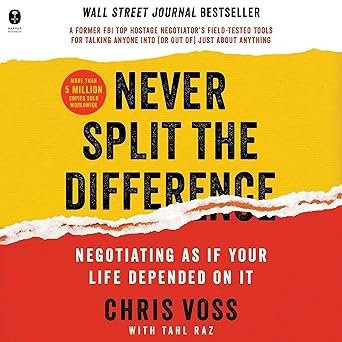
Verified Digital Release • Never Split the Difference by Chris Voss
📑 Table of Contents
📖 Visual Sketchnote Summary
Before diving deep into the cognitive mechanisms outlined by Chris Voss, let’s examine a quick quad-card sketchnote summary that captures the foundational pillars of the book:
1. Tactical Empathy
Understand the emotional reality of your counterpart without necessarily agreeing with it. Empathy is a cognitive tool.
2. Labeling Emotions
Call out your counterpart’s feelings explicitly (“It seems like you are hesitant about…”) to disarm resistance.
3. Master ‘No’
‘No’ is not the end; it’s the start. It gives your counterpart safety and control, making them feel secure.
4. Calibrated Questions
Use open-ended “How” and “What” questions to force the counterpart to solve your problems for you.
🧠 Book Architecture & Mindmap Breakdown
To fully grasp how Chris Voss structures his methodology, our cognitive review team has outlined the logical architecture below. If you enjoy deep psychological breakdowns like this, you might also appreciate our analysis in The 48 Laws of Power Review.
- 🌳 Root Core: Never Split the Difference (Chris Voss)
- 📁 Phase 1: The Mindset Shift
- Active Listening & Late-Night FM DJ Voice
- The Illusion of Control & Tactical Empathy
- 📁 Phase 2: Verbal Techniques & Tools
- Mirrors: Repeating the last 1-3 words
- Labels: Identifying dynamics with “It looks like…”
- The Power of ‘That’s Right’ over ‘You’re Right’
- 📁 Phase 3: Execution & Bargaining
- Bending Reality with Accusation Audits
- Calibrated Questions: “How am I supposed to do that?”
- The Ackerman Bargaining Model
- 📁 Phase 1: The Mindset Shift
Core Insights & Key Lessons from Chris Voss
When conducting any thorough book evaluation, we must examine the specific mechanics that create behavioral shifts. Voss spent decades negotiating with bank robbers, terrorists, and kidnappers where standard academic theories—such as Harvard’s “Getting to Yes” rational interest model—failed utterly. People in crises are not rational; they are emotional creatures trying to justify their actions logically.
A primary takeaway is the danger of splitting the difference. If you want a pair of shoes that cost $100 and I offer $50, splitting the difference gives us $75. Neither of us gets what we want, and nobody is satisfied. Instead, Voss teaches us to unearth the underlying variables by digging past the surface positions.
💡 Pro Strategy Tip: Want to explore more personal transformation titles? Check out our extensive archive at the Digital Haven Books bookstore for curated reading guides.
Furthermore, Voss introduces the concept of the Accusation Audit. Before your counterpart can pin negative assumptions on you, you list every terrible thing they might think about your proposal. By bringing these fears out into the open proactively, you defuse their emotional charge.
Ready to Master High-Stakes Communication?
Unlock the complete digital edition instantly and start applying FBI negotiation tactics today.
Frequently Asked Questions
1. Why does Chris Voss argue against splitting the difference?
Voss explains that splitting the difference often results in a bad compromise where neither party achieves their core objectives. It represents a lazy approach to bargaining that ignores creative, value-expanding solutions.
2. What is a ‘Calibrated Question’?
Calibrated questions are open-ended questions that begin with “How” or “What.” They disarm your counterpart and subtly force them to analyze your problems and help you solve them without feeling cornered.
3. Is this book useful for everyday life, or only business?
While widely acclaimed in corporate negotiations and sales, the book’s psychological tools are exceptionally effective for salary discussions, purchasing cars, managing interpersonal conflicts, and everyday relationship management.
Final Verdict & Digital Edition
For further reference, you can explore community discussions and ratings on Goodreads. Overall, Never Split the Difference is an essential manual for anyone looking to master human psychology, influence outcomes, and communicate with absolute confidence. Whether you are closing multi-million dollar deals or negotiating household chores, Chris Voss’s framework is transformative.
⚡ Secure Instant Download
Never Split the Difference (Ebook Edition)
Get immediate access to the complete digital book and start negotiating like an FBI hostage negotiator.

Previous Post
The Silent Patient Review: Core Insights,

Next Post



The 48 Laws Of Power Review: Full Breakdown & Mindmap | Digital Haven
[…] cognitive pillars. Much like exploring strategic negotiation tactics in resources such as our Never Split the Difference Review, understanding underlying motivations gives you complete clarity in social […]