



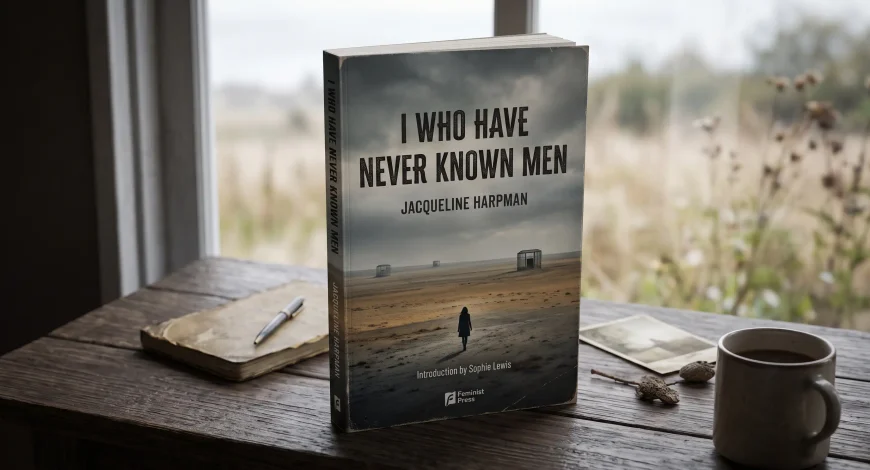
I Who Have Never Known Men: Best Summary & Ending Explained
Introduction :
Quick Answer: What Is I Who Have Never Known Men About?
I Who Have Never Known Men is Jacqueline Harpman’s haunting dystopian novel about forty women held in an underground cage by unseen guards. When the guards vanish, the youngest, who has no memory of the world, leads them into an empty landscape. The ending offers no neat answers.
Why I Who Have Never Known Men Still Haunts Readers
Imagine waking up in a cage, with no idea why you’re there, who put you there, or what the world outside looks like.
Now imagine that you’re the youngest prisoner and have never known anything else.
That’s the premise of I Who Have Never Known Men, the cult Belgian novel that keeps resurfacing on BookTok and Goodreads. It’s quiet and stripped down, and it will stay with you long after the last page.
One note on genre: this isn’t a conventional psychological thriller. It’s a bleak, philosophical dystopian novel, but it delivers the same dread, the same what is going on? tension, and the same urge to read “just one more chapter.” If you loved the unease of Dear Debbie, this one belongs on your shelf. We’ve covered that one in our Dear Debbie summary and ending explained.
Want to read it right now? Get the I Who Have Never Known Men ebook here and start tonight.
Table of Contents
Plot Summary & Premise (Spoiler-Light)
Jacqueline Harpman first published the novel in French in 1995 as Moi qui n’ai pas connu les hommes. The English translation followed, and a recent wave of reissues has brought it a new audience.
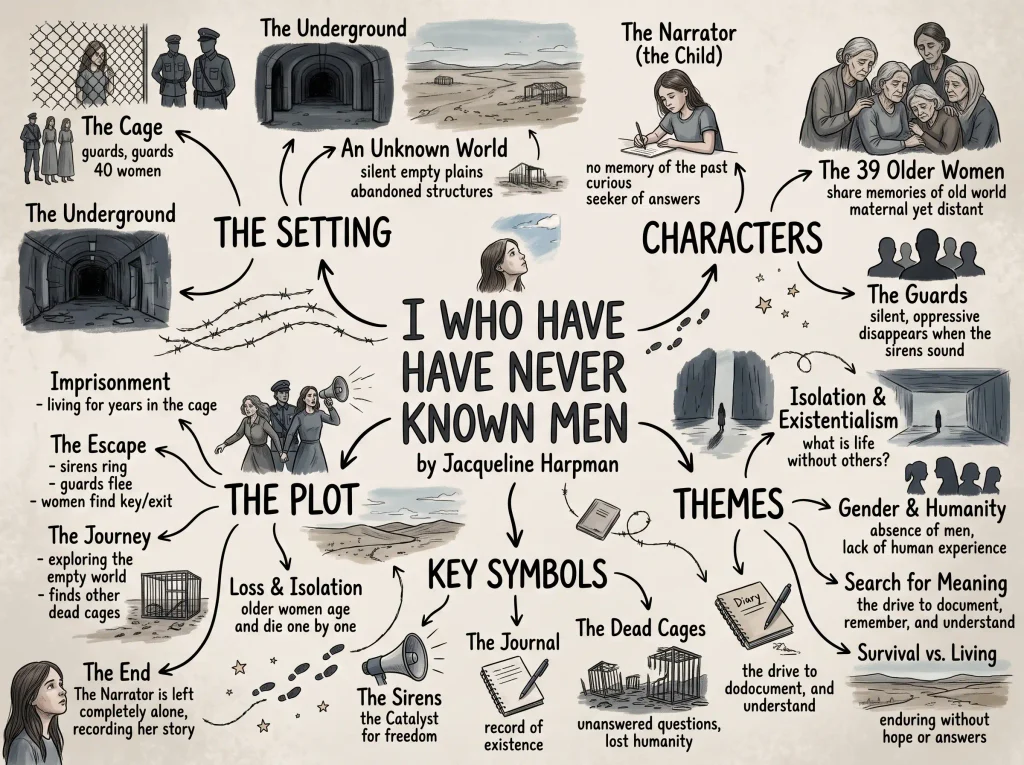
The story opens in an underground cell. Forty women are locked in a cage under constant watch by male guards. Nobody explains why they’re there or who is in charge.
The narrator is the youngest by many years. She has no memory of life before the cage, so she’s the only one who isn’t mourning a lost world. The older women remember husbands, children, homes and cities. She remembers nothing.
Then something changes, and the women are suddenly free to leave. What follows is a journey through a strange, silent world where nothing is quite as expected.
The book is built around questions:
- Who built the cage?
- Why these women?
- What happened to the rest of the world?
Harpman is in no hurry to answer, and that restraint is the source of the book’s power.
Character Breakdown
The cast is deliberately sparse and archetypal, which makes the emotional hits land harder.
The Narrator
She is unnamed, curious and unflinchingly honest. Because she has no past to cling to, she asks the questions the other women have learned to avoid. She is the philosophical heart of the book.
The Older Women
They carry memories of the lost world, and each copes differently. Some cling to hope, some to routine, and some give up. Their distinct reactions to captivity and freedom make the novel feel like a study of grief.
The Guards
They are barely characters, and that’s the point. Their silence and the absence of any explanation turn them into a symbol of faceless, unaccountable power.
Ending Explained: What Does It Really Mean?
Spoiler warning: skip to the next section if you haven’t finished the book.
The ending of I Who Have Never Known Men is one of the most searched and debated in modern dystopian fiction, because Harpman never gives the answer readers want.
The women’s journey doesn’t end in rescue or revelation. One by one they die, and the narrator ends up alone, recording her story to the end. The world’s mystery is never solved.
So what does it mean? Readers generally land on three interpretations:
- Meaning is something we make. With no explanation available, the narrator creates meaning through memory, observation and writing.
- A life is valuable even without a “purpose.” She insists she has lived, even though she never knew love, family or a normal world.
- A warning about power and silence. The unexplained cage reads as a metaphor for oppression that never justifies itself.
The ambiguity is the whole design, and it’s why the book sparks such intense discussion.
Review & Reader Takeaways
Why people love it:
- Spare, hypnotic prose that reads fast
- A narrator you won’t forget
- Big philosophical questions in a short book
- An ending that begs to be discussed
Common criticisms:
- Readers who want answers may feel frustrated
- The pacing is deliberately slow and contemplative
- It’s bleak
Reader consensus: It’s a short, devastating read that divides people at first and then gets under their skin. Many call it one of the best feminist dystopian novels, and the kind of book you immediately want to talk about.
Quick Comparison Table
| Feature | I Who Have Never Known Men |
|---|---|
| Author | Jacqueline Harpman |
| Original Language | French (1995) |
| Genre | Dystopian / philosophical fiction |
| Core Themes | Captivity, meaning, memory, womanhood, freedom |
| Pacing | Slow-burn, contemplative |
| Tone | Haunting, bleak, thought-provoking |
| Length | Short, quick to read |
| Best Format | Ebook (easy to read in one or two sittings) |
| Great For | Fans of dystopian and literary thrillers, book clubs |
Who Should Read This Book?
Pick up I Who Have Never Known Men if you:
- Love dystopian fiction that makes you think
- Enjoy ambiguous endings and book-club debates
- Want a short read with a long afterlife
Skip it if you need tidy resolutions and fast action.
Ready to Read I Who Have Never Known Men?
Don’t let this one sit on your TBR. Grab your digital copy of I Who Have Never Known Men from Digital Haven Books and read it on any device.
Then come back and tell us how you interpreted that ending. And if you want another unsettling read, check our Dear Debbie summary and ending explained.
FAQ
What is I Who Have Never Known Men about?
Forty women are imprisoned underground and later find themselves free in a deserted world, seen through the eyes of the youngest, who has no memory of life before the cage.
Is I Who Have Never Known Men a thriller?
Not strictly. It’s a dystopian literary novel with strong thriller-like tension and mystery.
Does the book explain why the women were imprisoned?
No. The lack of explanation is central to its meaning.
Is it a quick read?
Yes, it’s short and easy to finish in a sitting or two.