



The Psychology of Money Review: Core Insights, Mindmap & Summary
Welcome to our comprehensive The Psychology of Money Review, where we dissect one of the most influential personal finance books of our generation. When discussing financial literature, many assume the conversation will center around spreadsheets, compound interest formulas, and asset allocation percentages. However, Morgan Housel radically flips this narrative on its head. In his landmark book, Housel posits that doing well with money has a little to do with how smart you are and a lot to do with how you behave. And behavior, as we know, is notoriously difficult to manage.
Whether you are trying to escape the paycheck-to-paycheck cycle, build long-term generational wealth, or simply understand why you make impulsive financial choices, this book serves as an eye-opening manual. In this extensive review, we will explore Housel’s core philosophies, examine behavioral traps, unpack actionable frameworks, and provide you with everything you need to transform your relationship with wealth. Let’s dive deep into the mechanics of what makes this modern classic an absolute must-read.
⚡ Official Digital Edition
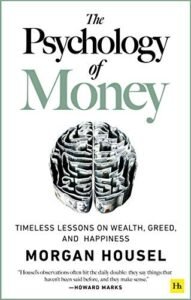
Verified Digital Release • The Psychology of Money by Morgan Housel
Understanding the Core Thesis of The Psychology of Money Review
To truly appreciate Morgan Housel’s masterwork, one must understand that money is not just a mathematical tool; it is a psychological mirror. Traditional economics assumes that human beings are rational actors who make calculated decisions to maximize utility. Yet, real life completely contradicts this assumption. We buy things we don’t need to impress people we don’t like; we panic-sell during market downturns because of evolutionary fear; and we anchor our financial self-worth to arbitrary societal benchmarks.
Housel approaches this reality through 20 short, story-driven chapters that read more like engaging historical essays than dry financial textbooks. Drawing inspiration from behavioral economics, historical anecdotes, and personal observations, he illustrates that our individual worldview of money is shaped by when and where we were born, our parents’ financial struggles or successes, and our unique cultural environment. You can explore more background details on the author via the Morgan Housel Wikipedia Profile.
📌 Sketchnote Summary Board: 4 Core Pillars
Visual breakdown of the most critical conceptual takeaways from Morgan Housel’s framework.
1. True Wealth is Invisible
Spending money to show people you have money is the fastest way to have less money. Real wealth is what you don’t see.
2. Freedom Over Status
The highest form of wealth is the ability to wake up every morning and say, “I can do whatever I want today.” Control your time.
3. Margin of Safety
Plan for things to not go according to plan. Room for error is the only reliable defense against unknown future volatility.
4. Compounding Magic
Warren Buffett’s secret isn’t just high returns; it’s the sheer number of years compounding has worked its silent magic on his capital.
Key Lessons & Insights Explored in The Psychology of Money Review
One of the recurring themes throughout Housel’s writing is the profound distinction between being wealthy and being rich. Being rich is current income—driving a luxury sports car, wearing designer clothes, and living in a sprawling mansion. Being wealthy, however, is hidden. It is the unspent income, the investment portfolio, the bank reserves, and the absolute freedom to walk away from a toxic job or a bad business deal.
Furthermore, Housel explores the concept of rationality versus reasonableness. In finance, people often strive to be purely rational. But Housel argues that you should aim to be reasonable instead. Reasonable is more realistic, and you can stick to it for a long period. If your financial strategy requires you to live like a monk for 30 years without any joy, it is mathematically optimal on paper but practically doomed in reality.
To understand the science behind human decision-making under uncertainty, many behavioral researchers reference foundational studies such as those highlighted in Dan Gilbert’s TED Talk on Happiness, which parallels Housel’s views on how poorly we forecast our future desires.
Book Architecture & Execution Mindmap
To help you operationalize the wisdom found in this book, we have structured Housel’s philosophy into an interactive execution tree below:
🌳 Central Philosophy: The Psychology of Money Framework
Branch 1: Humility & Luck
Acknowledge that success and failure are never as extreme as they look. Respect the immense role of luck.
Branch 2: Room for Error
Never rely on single-point forecasts. Build robust emergency savings and financial cushions for rainy days.
Branch 3: Long Horizons
Give your investments time to grow. Staying in the game through market cycles matters more than timing the peak.
Branch 4: Changing Goals
Accept that you will change over time. Avoid extreme long-term rigidity that ignores your evolving life stage.
Instant Digital Delivery
Start Reading The Psychology of Money in the Next 2 Minutes
Get immediate access to the full digital eBook edition. Read seamlessly on any phone, tablet, Kindle, or computer.
Detailed Critical Evaluation: Pros and Cons
No book review is complete without an objective look at the strengths and potential limitations of the text. Morgan Housel’s book has garnered widespread critical acclaim, but it is helpful to analyze who will benefit most from its pages.
The Strengths
- Engaging Storytelling Style: Housel avoids dense academic jargon, utilizing captivating historical tales that stick in your memory long after you finish reading.
- Focus on Psychology Over Math: By addressing emotional triggers like greed, fear, and ego, he solves the root cause of poor financial management rather than just treating symptoms.
- Short, Punchy Chapters: The book is structured for modern attention spans, making it easy to digest in short reading sessions or audio-book format.
The Limitations
- Not a Step-by-Step Blueprint: Readers looking for rigid, technical blueprints on index fund selection, tax optimization, or real estate syndication will not find step-by-step spreadsheets here.
- Philosophical Tone: The advice leans heavily toward mindset and lifestyle philosophy, which may feel too conceptual for absolute beginners seeking immediate tactical tasks.
For additional reader reviews, ratings, and community discussions, check out The Psychology of Money on Goodreads.
Final Verdict and Recommendation
To conclude our The Psychology of Money Review, Morgan Housel has produced an enduring masterpiece that belongs on the bookshelf of every investor, entrepreneur, and professional. It provides something much more valuable than a hot stock tip or a get-rich-quick formula: it grants you emotional clarity, peace of mind, and a healthier psychological framework for evaluating risk, reward, and personal fulfillment.
If you are ready to stop stressing over daily market fluctuations and start building a sustainable, freedom-driven relationship with your finances, this book is an essential read. Expand your personal growth library by exploring more titles on our Digital Haven Books bookstore, or secure your digital copy today and begin your journey toward financial wisdom.

Previous Post