What if you could walk into any high-stakes conversation—whether negotiating a six-figure salary raise, closing a business deal, or handling a difficult relationship—and consistently get what you want without triggering confrontation?
In “Never Split the Difference: Negotiating As If Your Life Depended On It”, former FBI lead international kidnapping negotiator Chris Voss reveals the battle-tested behavioral psychology principles he developed through his work with The Black Swan Group.
Traditional negotiation literature tells you to seek compromise and “split the difference.” However, Chris Voss proves that compromise is often a disastrous error that leaves both parties dissatisfied.
Table of Contents
Quick Overview: Why Splitting the Difference Fails
When a hostage taker demands four million dollars and the negotiator says, “Let’s split the difference and make it two million,” nobody wins. Real-world negotiations operate on the exact same logic. Persuasion is never about brute logic or aggressive bargaining; it is entirely rooted in emotional intelligence, psychological leverage, and tactical empathy.
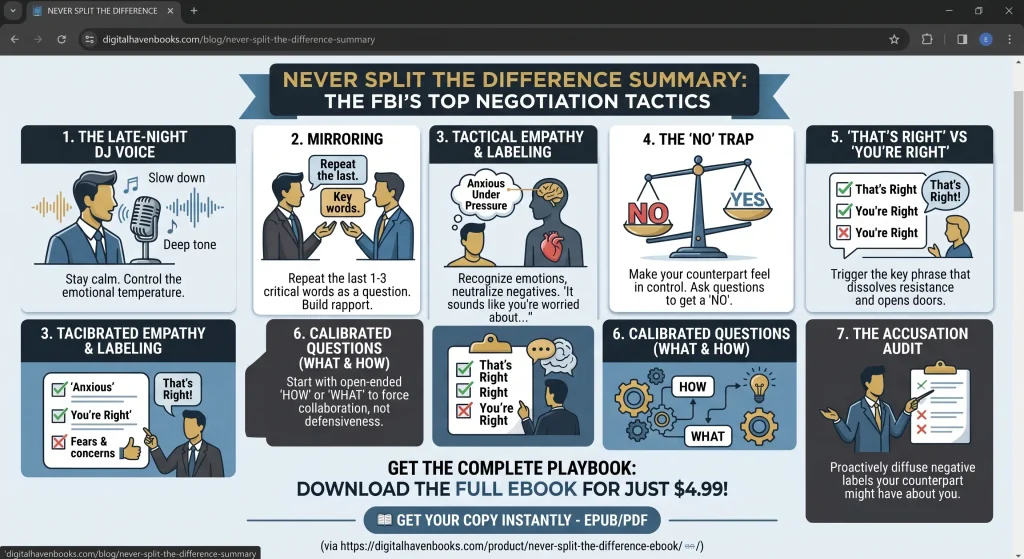
When emotional tension spikes, lower your vocal pitch and slow your cadence. A calm, deep, downward-inflecting voice instantly soothes the counterpart’s nervous system and signals that you maintain total emotional control over the room.
2. The Power of Tactical Mirroring
Mirroring is the simple act of repeating the last three critical words (or one to three key terms) of what your counterpart just said, paired with an upward questioning inflection. This subtle technique encourages the other party to elaborate and reveal their true underlying constraints without feeling cross-examined.
3. Tactical Empathy and Labeling
Never dismiss or argue against negative emotions. Instead, defuse them proactively by naming them out loud:
“It sounds like you’re concerned this delivery schedule is completely unrealistic.”
“It seems like you feel your contributions haven’t been properly recognized.” Labeling neutralizes negative emotional triggers and builds immediate rapport.
4. Beware the Trap of “Yes” — Push for “No”
People frequently say “Yes” merely to escape an uncomfortable conversation or avoid social pressure. But saying “No” provides a feeling of safety, security, and autonomy. Reframe your questions so that the desired path requires a negative answer:
Instead of: “Do you have a few minutes to talk?”
Ask: “Is now a bad time to discuss this project?”
5. Strive for “That’s Right” Over “You’re Right”
When someone replies with “You’re right”, they are usually dismissing you to end the interaction. However, when you summarize their feelings and perspective so accurately that they declare “That’s right”, their psychological defenses drop completely, paving the way for agreement.
6. Calibrated Questions: Master the “How” and “What”
Avoid questions beginning with “Why”, which inevitably provoke defensive justifications. Instead, utilize open-ended calibrated questions that give the illusion of control while prompting the counterpart to solve your logistical obstacles:
“How am I supposed to execute that on this budget?”
“What is the core issue preventing us from moving forward?”
7. Execute the “Accusation Audit”
Prior to making a difficult proposal, compile a comprehensive list of every terrible thing the counterpart could potentially think or say about you. Voice those accusations upfront. Once you neutralize their unexpressed grievances, your actual request appears remarkably reasonable by comparison.
Critical Reception and Why It Ranks Among the Best
Praised globally as one of the most practical negotiation handbooks ever written, the title holds an outstanding community rating on Goodreads. Rather than theoretical business jargon, Voss delivers concrete psychological scripts capable of altering outcomes across corporate, financial, and personal discussions.
📖 Master the Complete Negotiation Framework
Elevate your persuasion and communication mastery today. Download your full digital copy in universal formats ready for immediate reading:
Formats: Universal EPUB & PDF (Compatible with Kindle, Apple Books, Android, iPad & Desktop)
Delivery: Instant high-speed download link delivered straight to your email