



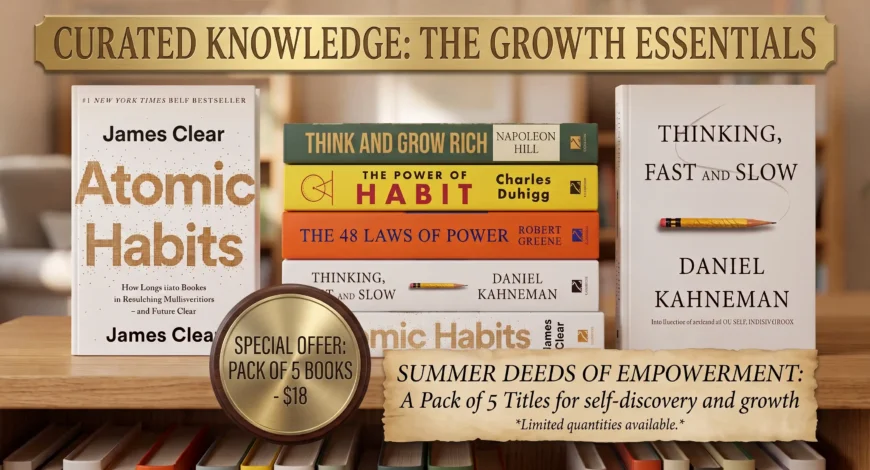
Top 5 Must-Read Books for Personal Growth & Success | 2026
Introduction
In the fast-paced world we live in today, personal growth is not just a luxury but a necessity. Whether you are an entrepreneur looking to scale your business, a professional aiming for that next promotion, or simply an individual seeking to improve your daily life, the right knowledge can be the catalyst for transformative change. While the internet offers endless snippets of advice, there is something profound about diving deep into a well-structured book that has stood the test of time. These pages offer not just information, but wisdom that has been refined through research, experience, and countless success stories.
For residents of our local community and beyond, accessing these resources is easier than ever. Local libraries, bookstores, and online platforms like Digital Haven Books
have made it possible to get your hands on these life-changing titles with just a few clicks or a short trip downtown. In this comprehensive guide, we will explore five seminal works that have shaped the minds of millions globally. We will delve into their core concepts, analyze why they remain relevant, and discuss how you can apply their lessons specifically within the context of our local entrepreneurship and business initiatives
. From mastering your daily routines to understanding the complexities of human power dynamics and decision-making, these books provide the blueprint for a richer, more successful life..
Table of Contents

1. Atomic Habits by James Clear: The Art of Small Changes
James Clear’s Atomic Habits has revolutionized the way we think about self-improvement. Unlike many self-help books that focus on massive, overnight transformations, Clear argues that real change comes from the compound interest of small, consistent actions. The premise is simple yet powerful: getting one percent better every day leads to remarkable results over time. This concept resonates deeply with individuals in our region, where the hustle culture often demands immediate results, leading to burnout. Clear’s approach offers a sustainable alternative.
The core of the book revolves around the “Four Laws of Behavior Change,” which serve as a practical framework for building good habits and breaking bad ones. The first law is to make it obvious. This involves designing your environment so that cues for good habits are visible. For instance, if you want to read more, place a book on your pillow every morning. The second law is to make it attractive. We are more likely to engage in behaviors that offer immediate rewards. Clear suggests “temptation bundling
,” where you pair an action you want to do with an action you need to do. The third law is to make it easy. Human behavior follows the path of least resistance, so reducing friction for good habits is crucial. Finally, the fourth law is to make it satisfying. Immediate reinforcement ensures that a behavior is repeated.
One of the most impactful concepts in Atomic Habits is habit stacking
. This technique involves linking a new habit to an existing one. For example, “After I pour my morning coffee (current habit), I will meditate for one minute (new habit).” This method leverages the neural pathways already established in your brain, making it easier to adopt new behaviors. For local professionals and students, this can mean integrating learning or fitness routines seamlessly into their existing commute or work schedule.
The relevance of Atomic Habits extends beyond the individual to the community level. In our city, where small businesses and startups are thriving, the discipline of incremental improvement can be the difference between failure and success. A local cafe owner who improves their customer service by one percent every day will, within a year, offer an experience vastly superior to their competitors. Similarly, a student who studies for just twenty minutes extra each day will see their grades soar by the end of the semester.
Clear also emphasizes the importance of identity-based habits. Instead of focusing on what you want to achieve (outcome-based), focus on who you wish to become (identity-based). If you want to run a marathon, don’t just say “I want to run a marathon.” Say, “I am a runner.” This shift in perspective changes your behavior because you act in accordance with your identity. For readers in our area, adopting an identity of “lifelong learner” or “community leader” can drive actions that benefit both personal goals and the wider society.
To find your copy of Atomic Habits, you can visit local bookshops or order online through Digital Haven Books
, which often hosts community discussions on habit formation via our monthly community book clubs
. By applying Clear’s principles, you can build a life where success is not a singular event but a lifestyle.
2. The 48 Laws of Power by Robert Greene: Mastering Social Dynamics
Robert Greene’s The 48 Laws of Power is a controversial yet undeniably influential book that distills three thousand years of history into 48 distinct laws. While some critics argue that the book promotes manipulation, a closer reading reveals it as a manual for understanding the power dynamics that exist in every workplace, social circle, and political arena. Ignorance of these laws does not protect you from them. In fact, it makes you vulnerable to those who do understand them. For professionals navigating the competitive landscape of our local job market, understanding these dynamics is essential for career advancement and self-preservation.
The book draws examples from historical figures like Niccolò Machiavelli
, Sun Tzu
, and Talleyrand, as well as modern celebrities and CEOs. One of the most cited laws is Law 1: “Never Outshine the Master.” This law advises that you should always make those above you feel comfortably superior. In your desire to please or impress, do not go too far in displaying your talents, or you might accomplish the opposite: inspire fear and insecurity. Make your masters appear more brilliant than they are, and you will attain the heights of power. In a corporate setting within our city, this could mean giving credit to your supervisor for team successes, thereby securing their support for your future projects.
Another critical lesson is Law 3: “Conceal Your Intentions.” Keep people off-balance and in the dark by never revealing the purpose behind your actions. If they have no clue what you are up to, they cannot prepare a defense. Guide them far enough down the wrong path, envelop them in enough smoke, and by the time they realize your intentions, it will be too late. While this sounds Machiavellian, in a business negotiation context, it simply means maintaining a degree of privacy regarding your bottom line until the optimal moment.
Law 32, “Play to People’s Fantasies,” is particularly relevant in marketing and sales. People are often drawn to the romantic and the idealistic rather than the bitter truth. When appealing to the masses, avoid ugly realities and focus on the dream. Local entrepreneurs can apply this by crafting brand stories that resonate with the aspirations of our community, rather than just listing product features.
Greene also warns against trust in Law 2: “Never Put Too Much Trust in Friends; Learn How to Use Enemies.” Friends will betray you quickly out of envy, but a former enemy who is brought into the fold will be more loyal because they have more to prove. This law challenges the conventional wisdom of surrounding oneself only with yes-men. In our diverse community, embracing constructive criticism from skeptics can lead to more robust business strategies and personal growth.
It is important to approach The 48 Laws of Power with a balanced mindset. You do not need to use these laws to manipulate others maliciously. Instead, view them as a defensive shield. By recognizing when these tactics are being used against you, you can protect your interests and navigate social complexities with grace. Whether you are negotiating a salary, managing a team, or engaging in local politics, the insights from Greene’s work are invaluable. Copies of this provocative title are available at Digital Haven Books’ Leadership & Strategy Section
, where staff can guide you to complementary titles on ethics and leadership to provide a well-rounded perspective.
3. The Power of Habit by Charles Duhigg: Understanding the Loop
While James Clear focuses on the “how” of building habits, Charles Duhigg’s The Power of Habit dives deep into the “why.” Duhigg, a Pulitzer Prize-winning reporter, explores the science behind why habits exist and how they can be changed. The central concept of the book is the “Habit Loop
,” a neurological pattern that governs any habit. This loop consists of three elements: a cue, a routine, and a reward. Understanding this loop is the key to unlocking the potential for change in our personal and professional lives.
The cue is the trigger that tells your brain to go into automatic mode. It could be a location, a time of day, an emotional state, or other people. The routine is the behavior itself, which can be physical, mental, or emotional. The reward is the positive reinforcement that tells your brain this loop is worth remembering for the future. Duhigg illustrates this with fascinating case studies, ranging from individuals trying to quit smoking to major corporations like Starbucks training their employees to handle difficult customers.
One of the most compelling aspects of The Power of Habit is the concept of “keystone habits.” These are small changes or behaviors that unintentionally carry over into other aspects of life. For example, starting a daily exercise routine might lead to better eating habits, increased productivity at work, and even more patience with family members. Identifying and cultivating keystone habits can create a ripple effect of positive change. For residents of our area, a keystone habit could be something as simple as a morning walk in the local park, which sets a tone of health and vitality for the rest of the day.
Duhigg also discusses the role of willpower. He cites research showing that willpower operates like a muscle
that can get tired, but can also be strengthened through practice. By turning strenuous tasks into habits, we conserve our willpower for more critical decisions. This is particularly relevant for students and entrepreneurs who face constant decision fatigue. By automating mundane tasks through habit, they free up mental energy for innovation and strategic thinking.
The book also touches on the power of community and belief in changing habits. Duhigg shares the story of Alcoholics Anonymous, highlighting how the group aspect and the belief in a higher power help individuals break addictive loops. This underscores the importance of social support systems. In our tight-knit community, joining local groups, whether they are running clubs, business networks, or book clubs, can provide the accountability needed to sustain new habits.
Furthermore, Duhigg explains how organizations have their own habits, often referred to as company culture. Changing these organizational habits requires understanding the existing loops and introducing new routines that align with desired outcomes. Local business leaders can use these insights to foster a culture of innovation and efficiency. By recognizing the cues and rewards that drive employee behavior, managers can create environments that naturally encourage productivity and collaboration.
The Power of Habit is a testament to the idea that while habits are deeply ingrained, they are not immutable. With the right understanding of the underlying mechanisms, anyone can rewrite their neural pathways. Whether you are looking to improve your health, boost your career, or strengthen your relationships, Duhigg’s research provides a roadmap. To start your journey of transformation, reserve your copy at Digital Haven Books
and check out our guide on building sustainable daily routines
for collective success.
4. Think and Grow Rich by Napoleon Hill: The Philosophy of Achievement
First published in 1937, Napoleon Hill’s Think and Grow Rich remains one of the best-selling personal finance and self-improvement books of all time. Commissioned by steel magnate Andrew Carnegie, Hill spent over two decades interviewing the most successful people of his time, including Henry Ford, Thomas Edison, and Alexander Graham Bell. The result was a distilled philosophy of success that transcends generations. While the title suggests a focus on monetary wealth, the book is truly about achieving richness in all areas of life, including relationships, health, and spiritual peace.
At the heart of Hill’s philosophy is the idea that “thoughts are things.” He posits that the human mind is capable of creating reality through the power of thought, faith, and persistence. The famous concept of the “Law of Attraction” is rooted in this book, suggesting that whatever the mind can conceive and believe, it can achieve. This message of empowerment is particularly resonant for aspiring entrepreneurs in our region who may face economic hurdles or skepticism. Hill teaches that limitations exist only in the mind.
One of the key principles outlined in the book is the “Master Mind” alliance. Hill defines this as the coordination of knowledge and effort of two or more people toward a definite purpose. He argues that no individual achieves great success alone. The synergy created when like-minded individuals come together generates a form of invisible energy that propels everyone involved to greater heights. For our local business community, forming peer mastermind groups
can be a game-changer. These groups provide a platform for sharing resources, solving problems collectively, and holding each other accountable.
Hill also emphasizes the importance of definiteness of purpose. Without a clear, written goal, effort is scattered and ineffective. He encourages readers to define exactly what they want, by when, and what they are willing to give in return. This clarity acts as a magnet, drawing opportunities and resources toward the individual. In a world full of distractions, having a burning desire and a specific plan is crucial.
Another vital component is the concept of “auto-suggestion.” This involves feeding your subconscious mind with positive affirmations and visualizations of your goals. By repeatedly telling yourself that you are capable and that you will succeed, you reprogram your brain to look for opportunities rather than obstacles. This technique is widely used by athletes and high performers today.
Critics sometimes dismiss Think and Grow Rich as overly simplistic or dated. However, the core psychological principles remain valid. The emphasis on mindset, resilience, and the power of community is timeless. In our modern context, these principles can be applied to digital entrepreneurship, creative arts, and social innovation. The book serves as a reminder that wealth is not just about money, but about the freedom to live life on your own terms.
For those in our community looking to ignite their ambition, Think and Grow Rich is an essential read. It challenges you to examine your beliefs and take massive action toward your dreams. You can explore this classic text by visiting The Napoleon Hill Foundation
or picking up a copy at Digital Haven Books. There, you can also browse our Personal Finance & Mindset Collection
that bridges the gap between 1930s philosophy and modern financial reality.
5. Thinking, Fast and Slow by Daniel Kahneman: Decoding Decision Making
Daniel Kahneman, recipient of the 2002 Nobel Memorial Prize in Economic Sciences
, offers a groundbreaking exploration of the human mind in Thinking, Fast and Slow. Unlike the previous books that focus on action and mindset, Kahneman’s work delves into the mechanics of how we think and make decisions. He introduces two systems that drive our thoughts: System 1 and System 2. System 1 is fast, intuitive, and emotional. It operates automatically and with little effort. System 2 is slower, more deliberative, and more logical. It allocates attention to the effortful mental activities that demand it.
Understanding the interplay between these two systems is crucial for avoiding cognitive biases
and making better decisions. Kahneman reveals how System 1 often leads us astray with heuristics, or mental shortcuts, that result in systematic errors. For example, the “anchoring bias
” causes us to rely too heavily on the first piece of information offered when making decisions. In a negotiation or purchasing scenario, the initial price set often anchors our perception of value, regardless of the actual worth. Being aware of this can save consumers and business owners in our area significant amounts of money.
Another common bias discussed is the “availability heuristic
,” where we judge the probability of an event based on how easily examples come to mind. If a local news story highlights a rare crime, residents might overestimate the danger of their neighborhood, leading to unnecessary fear or poor investment choices. Kahneman teaches us to pause and engage System 2 to analyze data objectively rather than relying on vivid anecdotes.
The book also covers the concept of “loss aversion
,” which suggests that the pain of losing is psychologically about twice as powerful as the pleasure of gaining. This bias often prevents people from taking calculated risks that could lead to significant rewards. For entrepreneurs in our community, understanding loss aversion can help in framing proposals and overcoming the fear of failure that stifles innovation.
Kahneman’s insights are not limited to economics. They apply to healthcare, law, education, and everyday personal choices. By recognizing when we are operating on autopilot (System 1) and consciously engaging our analytical minds (System 2), we can improve the quality of our judgments. This is particularly important in an age of information overload, where quick reactions are often rewarded over thoughtful analysis.
Furthermore, Thinking, Fast and Slow encourages a culture of questioning and skepticism. It teaches us that confidence is not a reliable indicator of accuracy. A person can be confidently wrong. Therefore, seeking diverse perspectives and verifying facts is essential. In our local governance and community planning, applying these principles can lead to more rational policies and better resource allocation.
Reading Kahneman’s work is an intellectual workout that sharpens your critical thinking skills. It equips you with the tools to navigate a complex world with greater clarity and less bias. Whether you are investing your savings, hiring a new employee, or deciding on a major life change, the lessons from this book are indispensable. To deepen your understanding of human psychology and decision-making, grab a copy from Digital Haven Books’ Behavioral Science Catalog
. Engaging with this text will not only make you a smarter consumer but also a more thoughtful citizen.
Conclusion: Your Journey to Mastery Begins Now
The five books we have explored—Atomic Habits, The 48 Laws of Power, The Power of Habit, Think and Grow Rich, and Thinking, Fast and Slow—offer a comprehensive toolkit for personal and professional development. Together, they cover the spectrum of human potential: from the micro-level of daily routines to the macro-level of strategic power plays, from the psychological roots of behavior to the philosophical drivers of wealth, and finally, to the cognitive mechanisms of decision-making.
Reading these books is not a passive activity. The true value lies in application. Knowledge without action is merely entertainment. We encourage you to pick one book from this list and commit to implementing at least one principle from it this week. Maybe it’s stacking a new habit onto your morning routine, identifying a keystone habit to change, forming a mastermind group with local peers, or simply pausing to engage System 2 thinking before making a significant purchase.
Our community is filled with individuals who have transformed their lives through the power of reading and application. By engaging with these timeless works, you join a lineage of thinkers and doers who refuse to settle for mediocrity. Local resources like local public library networks
, community centers, and bookstores such as Digital Haven Books
are here to support your journey. They offer not just the books, but also spaces for discussion, workshops, and upcoming local literary events
that foster a culture of continuous learning.
Remember, personal growth is a marathon, not a sprint. It requires patience, persistence, and the willingness to fail and learn. As you delve into these pages, allow yourself to be challenged. Let go of old limiting beliefs and embrace new possibilities. The road to success is paved with the wisdom of those who came before us, and these five books are your map. Start today, turn the page, and begin writing your own story of success. The future belongs to those who prepare for it, and there is no better preparation than the pursuit of knowledge.Conclusion: Your Journey to Mastery Begins Now
The five books we have explored—Atomic Habits, The 48 Laws of Power, The Power of Habit, Think and Grow Rich, and Thinking, Fast and Slow—offer a comprehensive toolkit for personal and professional development. Together, they cover the spectrum of human potential: from the micro-level of daily routines to the macro-level of strategic power plays, from the psychological roots of behavior to the philosophical drivers of wealth, and finally, to the cognitive mechanisms of decision-making.
Reading these books is not a passive activity. The true value lies in application. Knowledge without action is merely entertainment. We encourage you to pick one book from this list and commit to implementing at least one principle from it this week. Maybe it’s stacking a new habit onto your morning routine, identifying a keystone habit to change, forming a mastermind group with local peers, or simply pausing to engage System 2 thinking before making a significant purchase.
Our community is filled with individuals who have transformed their lives through the power of reading and application. By engaging with these timeless works, you join a lineage of thinkers and doers who refuse to settle for mediocrity. Local resources like libraries, community centers, and bookstores are here to support your journey. They offer not just the books, but also spaces for discussion, workshops, and events that foster a culture of continuous learning.
Ready to start your transformation today? You can easily access this complete collection of life-changing titles in one convenient package. Visit Digital Haven Books now to purchase the Top 5 Must-Read Books bundle and take the first step toward mastering your mindset, habits, and future.
Remember, personal growth is a marathon, not a sprint. It requires patience, persistence, and the willingness to fail and learn. As you delve into these pages, allow yourself to be challenged. Let go of old limiting beliefs and embrace new possibilities. The road to success is paved with the wisdom of those who came before us, and these five books are your map. Start today, turn the page, and begin writing your own story of success. The future belongs to those who prepare for it, and there is no better preparation than the pursuit of knowledge.

Previous Post