



The Power of Habit by Charles Duhigg: Summary, Habit Loop & Key Lessons
The Power of Habit: Why We Do What We Do in Life and Business – Ultimate SEO Guide
Table of Contents
Introduction: Unlocking the Science of Behavioural Change
Ever wondered why you can effortlessly drive home along the exact same route every single day, yet remember almost nothing about the actual journey? Or why breaking a late-night snacking routine feels like fighting an invisible, overpowering force? According to Pulitzer Prize-winning business reporter Charles Duhigg in his groundbreaking book, The Power of Habit, our lives are essentially a massive collection of automated routines.
Published by Random House, The Power of Habit: Why We Do What We Do in Life and Business explores the profound neurological mechanisms that govern our daily actions. Drawing on hundreds of academic studies and interviews with over three hundred scientists and executives, the book explores a singular, transformative argument: habits can be changed if we understand how they work.
Whether you are an entrepreneur looking to optimize your workflow, an individual seeking to break a destructive cycle, or a leader trying to reshape an entire organization, mastering the mechanics of habit formation is the ultimate catalyst for success. In this comprehensive guide, we will break down the core components of the habit loop, examine how cravings drive our routines, and reveal the golden rules for personal and organizational transformation.
As documented in behavioral psychology research and discussed by authors like Charles Duhigg on his official research notes, understanding the neurological loop…” CharlesDuhigg.com)
Part 1: The Habits of Individuals and The Habit Loop
To understand how habits control our daily actions, we must first look inside the human brain. Over 40 percent of the actions people perform each day are not actual decisions, but habits. This effort-saving instinct is an evolutionary advantage: an efficient brain requires less room, allows for easier childbirth, and frees up mental energy so we can invent technologies, write code, and build civilizations.
The Neurology of Chunking and the Basal Ganglia
Deep inside the brain, close to the brain stem, lies an ancient, golf-ball-sized lump of tissue known as the basal ganglia. During the early 1990s, researchers at the Massachusetts Institute of Technology (MIT) used micro-sensors implanted in the brains of rats to study how this region operates during maze navigation.
Initially, when a rat encountered a T-shaped maze and heard a click, its brain worked furiously, processing every new scent, sight, and sound. However, after running the same route hundreds of times, a remarkable mental shift occurred. The rat’s brain activity decreased dramatically. As the route became automatic, the rat stopped thinking, and the decision-making centers of the brain went quiet.
This neurological process—where the brain converts a sequence of actions into an automatic routine—is known as chunking. It sits at the very root of how habits form. Whether it is backing a car out of a driveway or typing out an email, our basal ganglia store these routines so the rest of the brain can rest or focus on other tasks.
The Three-Step Habit Loop
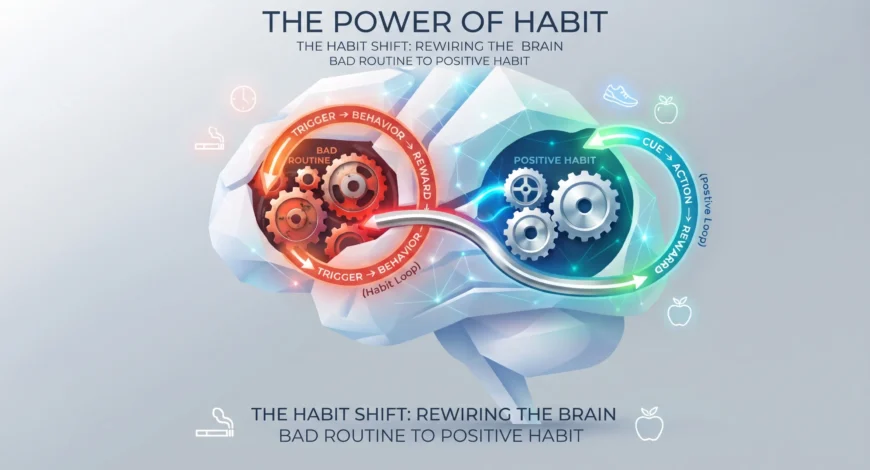
Every single habit in our lives operates through a continuous neurological feedback mechanism known as The Habit Loop:
- The Cue: A trigger that tells your brain to go into automatic mode and determines which specific habit to use. This can be a visual trigger, a time of day, an emotion, a sequence of thoughts, or the presence of specific people.
- The Routine: The physical, mental, or emotional behavior that follows the cue. This is the automated action itself.
- The Reward: A positive reinforcement that helps your brain figure out whether this particular loop is worth remembering for the future.
Over time, this loop becomes increasingly automatic. The cue and reward become intertwined until a powerful sense of anticipation and craving emerges, cementing the habit in place.
Part 2: The Craving Brain – How to Create New Habits
Understanding the habit loop explains why habits exist, but it took marketing pioneers like Claude Hopkins to demonstrate how new habits can be intentionally cultivated and grown.
Claude Hopkins and the Pepsodent Phenomenon
In the early 1900s, advertising executive Claude Hopkins was approached by a friend with a new minty toothpaste called Pepsodent. At the time, dental hygiene in America was appalling, and selling toothpaste was considered financial suicide because almost nobody brushed their teeth.
Hopkins realized that he needed a universal trigger to justify daily use. Diving into dental textbooks, he discovered a reference to “mucin plaques on teeth,” which he rebranded as “the film.” Hopkins launched a massive advertising campaign telling consumers to run their tongues across their teeth to feel the cloudy film, promising that Pepsodent would wash it away and create a beautiful smile.
The campaign was an overnight sensation. Within a decade, toothbrushing transformed from an obscure practice into a national daily ritual for more than half the American population. The secret to Hopkins’s success boiled down to two fundamental rules:
- Rule 1: Find a simple and obvious cue.
- Rule 2: Clearly define the rewards.
However, as neuroscientists later discovered, Hopkins’s formula was missing a crucial third ingredient: a craving. Pepsodent contained citric acid and mint oil, which created a cool, tingling sensation on the tongue and gums. Consumers grew to crave that physical tingle; if they forgot to brush, their mouths felt unclean. Hopkins was not just selling beautiful teeth; he was selling a physical sensation that powered the habit loop.
Part 3: The Golden Rule of Habit Change
One of the most liberating discoveries in behavioral psychology is that habits cannot be truly eradicated—they can only be replaced.
The Golden Rule of Habit Change
If you try to stop a bad habit purely through sheer willpower, you will likely fail when stress or fatigue sets in. Instead, you must apply The Golden Rule of Habit Change:
To change a habit, you must keep the old cue, and deliver the old reward, but insert a new routine.
This rule forms the foundation of highly successful programs like Alcoholics Anonymous (AA) and habit reversal training used by therapists worldwide.
Real-World Application: Overcoming Bad Habits
- Quitting Smoking: If you smoke during work breaks because you crave social interaction, stress relief, or a burst of mental stimulation, replacing the cigarette with nicotine gum or a quick walk with a colleague satisfies the underlying craving while altering the destructive routine.
- Stopping Afternoon Snacking: If you reach for chips every afternoon out of boredom rather than actual hunger, taking a five-minute walk or chatting with a coworker provides the exact same mental break without adding inches to your waistline.
Part 4: Keystone Habits – Which Habits Matter Most?
Not all habits carry equal weight. In The Power of Habit, Charles Duhigg introduces the concept of keystone habits—small changes or habits that spark a chain reaction, naturally dislodging and remaking other patterns across an individual’s life or an entire organization.
Paul O’Neill and Alcoa’s Safety Revolution
When Paul O’Neill took over as the CEO of the aluminum manufacturing giant Alcoa in 1987, Wall Street investors panicked when his opening speech focused entirely on worker safety rather than profits or cost-cutting.
O’Neill understood that he could not simply order thousands of unionized workers to be more productive. Instead, he made safety a non-negotiable keystone habit. His institutional habit loop was simple:
- Cue: An employee injury.
- Routine: Unit presidents had to report the injury to O’Neill within twenty-four hours, present an action plan, and fix the root cause.
- Reward: Promotions and career advancement were tied directly to embracing the safety system.
To comply with this rule, factory floors had to improve communication structures, allowing low-level workers to flag mechanical defects and operational bottlenecks immediately. Consequently, fixing safety issues streamlined manufacturing processes, drastically reduced material waste, and elevated product quality. By focusing on a single keystone habit, O’Neill transformed Alcoa into a profit powerhouse and one of the safest workplaces on earth.
Small Wins and the Power of Belief
Keystone habits foster widespread change by creating small wins—steady applications of small advantages that accumulate over time, proving that larger achievements are entirely within reach.
Furthermore, permanent habit transformation requires belief. Whether an alcoholic achieves sobriety through the community support of Alcoholics Anonymous or an athlete visualizes a flawless race like Olympic champion Michael Phelps, belief is the essential catalyst that makes a reworked habit loop stick during moments of high stress.
Part 5: Starbucks and the Habit of Success – Making Willpower Automatic
Willpower is the single most important keystone habit for individual success, outperforming IQ and technical talent in predicting academic and professional achievement. However, neuroscientists have proven that willpower is a finite muscle. When you use up your self-control on tedious tasks or stressful environments throughout the day, your mental energy depletes, making it much harder to resist temptations later on.
The LATTE Method and Inflection Points
Corporations like Starbucks successfully train entry-level workers and struggling individuals by turning self-discipline into an organizational habit. When employees face stressful inflection points—such as dealing with an angry, yelling customer—their willpower often collapses.
To prevent this, Starbucks trains baristas to use structured habit loops like the LATTE method:
- Listen to the customer.
- Acknowledge their complaint.
- Take action by solving the problem.
- Thank them.
- Explain why the problem occurred.
By preprogramming specific routines for high-stress scenarios, employees do not need to rely on exhausted willpower. They simply follow the automated habit loop, delivering exceptional customer service consistently and effortlessly.
Conclusion: Take Control of Your Habit Loops
Charles Duhigg’s The Power of Habit proves a liberating truth: while habits can run our lives on autopilot, they do not have to dictate our destiny. By understanding how the habit loop operates, identifying the specific cues and cravings that drive your daily routines, and intentionally inserting healthier alternative routines, you can completely reprogram your mind.
- ..which explains why millions of readers worldwide have rated and reviewed it on platforms like Goodreads The Power of Habit Page.”
Why Digital Haven Books is the Ultimate Destination for Smart Readers
If you want to build unshakeable routines, master your mindset, and transform your daily life, reading one book is just the beginning. At Digital Haven Books, we curate and deliver instant digital editions of the world’s most impactful bestsellers straight to your device. Whether you want to fix your finances, outsmart negotiations, or reprogram your daily routines, our digital library has everything you need.
Here are four top-selling digital books you should add to your reading list right now:
- The Psychology of Money by Morgan Housel – Master the timeless lessons on wealth, greed, and happiness.
- Never Split the Difference by Chris Voss – Learn high-stakes negotiation tactics used by FBI negotiators.
- Ego Is the Enemy by Ryan Holiday – Overcome your biggest internal obstacle to achieve true success.
- Atomic Habits by James Clear – The ultimate practical guide to building good habits and breaking bad ones.
Explore our entire collection today at Digital Haven Books Shop and download your next favorite e-book in seconds!

Previous Post