




Stop Trying to Look Rich: A Honest Review of The Psychology of Money Book
Mindset Over Math: Why Your Bank Account Cares More About Your Behavior, An Honest Review ofThe Psychology of Money

The Psychology of Money Review: Why Mindset Beats Math
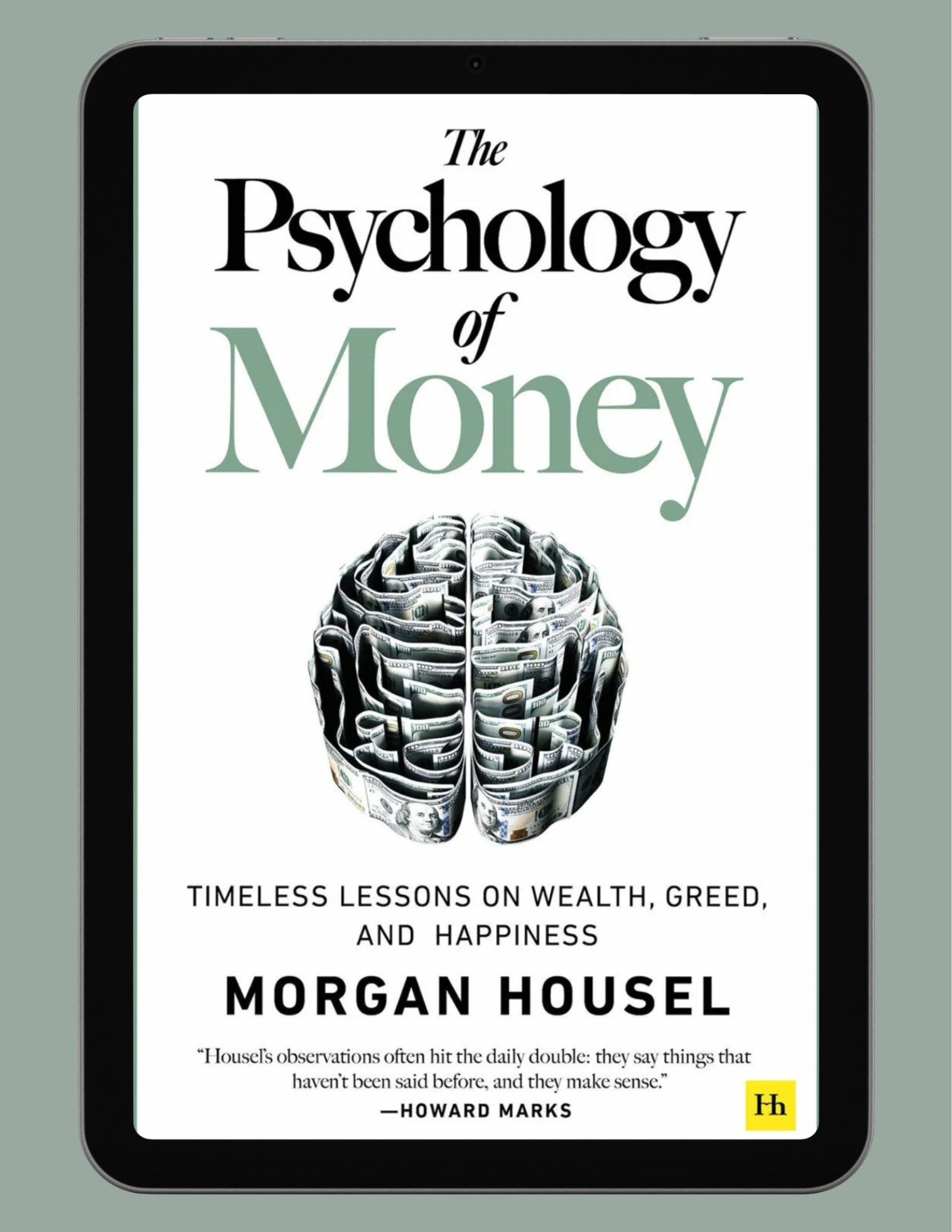
I just finished The Psychology of Money by Morgan Housel, and it completely changed how I think about my bank account.
This Psychology of Money review is for anyone who’s ever felt “bad with money” because they’re not a math person. The book’s central argument: wealth has almost nothing to do with intelligence and everything to do with behavior — and controlling your behavior is a lot harder than learning algebra.
Here’s my honest, hype-free breakdown of why this book is worth your time, plus where I think it falls short.
Table of Contents
🚗 The Janitor vs. The Harvard Exec
Housel opens with a true story that sets up the whole book.
Imagine two guys:

[ Ronald Read ] 🧹                     [ Richard Fuscone ] 💼
• Retired Janitor & Gas Station Guy    • Harvard-Educated Merrill Lynch Exec
• Clipped coupons, drove old truck    • Had the connections, the big money
• Quietly bought stocks & waited      • Borrowed huge, lived way too large
Result: Died with $8 MILLION! 🎉      Result: Went completely broke. 💥
Ronald Read was a retired janitor and gas station attendant. He clipped coupons, drove an old truck, and quietly bought stocks over decades. He died with $8 million.
Richard Fuscone was a Harvard-educated Merrill Lynch executive with connections and serious money. He borrowed heavily and lived large. He went completely broke.
(Source: The Washington Post — “The remarkable life and lessons of the $8 million janitor”)
The gap between them wasn’t intelligence — it was behavior. Ronald was patient. Richard was greedy. That’s the core thesis of this Psychology of Money review: managing money is a soft skill, not a spreadsheet skill. It’s less about what you know and more about how you act under pressure.
🧠 Part 1: Your Brain on Money (The Inner Game)
1. No One’s Actually Crazy
We all do weird stuff with cash. But here’s the thing: every financial decision you make makes total sense to you in the moment.
If you grew up when the stock market was tanking, you’ll naturally be terrified of investing.
If you grew up in a massive economic boom, you’ll probably love risk. We aren’t crazy; we’re just running on different life experiences. Give yourself a little grace!
2. The “Cool Car” Paradox
The truth about flashy things: When you see someone driving a Ferrari, you rarely look at the driver and think, “Wow, they’re so cool.” Instead, you immediately imagine yourself in the driver’s seat.
We buy fancy stuff to get respect, but the people we want to impress only care about the stuff, not us. Ouch. 😅
3. Be “Reasonable,” Not “Rational”
A cold, calculating math robot would tell you to invest in a specific way to squeeze out an extra 0.5% return. But you aren’t a robot. You’re a human who wants to sleep at night.
The rule: Pick a strategy that is reasonable enough that you can actually stick to it when the market goes nuts. A “good enough” plan you keep for 30 years beats a “perfect” plan you abandon the second you panic.
⚙️ Part 2: How the Money Game Actually Works
⏳ The Secret Sauce Is Time
Warren Buffett is a legendary investor, but here’s the detail most people miss: an estimated 95%+ of his net worth was built after age 65. His edge isn’t a secret formula — it’s that he started investing as a kid and let compounding run for an extremely long time. Compounding is a snowball; you just need a very long hill.
Wealth Is What You Don’t See
This book draws a sharp line between looking rich and being wealthy:
| Rich (The Show) 🏎️ | Wealthy (The Freedom) 🏖️ |
|---|---|
| Driving a $100k car. | Having the money to buy the car, but choosing not to. |
| Showing off a massive monthly credit card bill. | Having cash in the bank that buys you time and peace of mind. |
| It’s what you spend. | It’s what you save. |
🛡️ Part 3: How to Actually Keep Your Money
Getting rich and staying rich are two entirely different vibes:
Getting rich requires being an optimist, taking big swings, and putting yourself out there.
Staying rich requires the exact opposite: a little bit of healthy paranoia, humility, and realizing that everything could blow up tomorrow if you aren’t careful.
The best tool for this? A massive margin of safety. Always assume your plans won’t go perfectly. Keep extra cash on hand. It’s not “wasted” money—it’s the shield that keeps you from panic-selling your investments when life hits the fan.
👀 The “Reality Check” (What the Book Misses)
As much as I love this book, it’s not perfect. If we’re being real, there are a few blind spots:
You need money to start: Housel assumes you already have cash ready to compound. But early in your career, your absolute best asset is you—your skills, your side hustle, and your ability to earn more.
The playing field isn’t level: The book skews a bit towards a privileged demographic and glosses over systemic issues, debt traps, or how hard it is to build a “money mindset” when you’re starting from behind. (See: [LINK: article on wealth inequality/systemic barriers])
The housing market has changed: Housel treats buying a house mostly as an emotional decision. But with today’s wild mortgage rates and crazy prices, the math on “renting vs. buying” is a lot trickier than he makes it sound. (See: [LINK: current rent-vs-buy calculator or article])
🤓 Okay, Just a Tiny Bit of Math (Trust Me, It’s Cool)
If you do like a little bit of structure, think of your future wealth $W(t)$ like this:
$$W(t) = W_0 \cdot e^{r \cdot \beta \cdot t}$$
Don’t let the symbols scare you! Here is what they actually mean in plain English:
- W₀ = Your starting cash (what you’ve got right now).
- r = Your investment returns (how well your stocks/business do).
- t = Time (how long you leave it alone to grow).
- β = (Beta) Your “Chill Factor” (a score from 0 to 1).
Your Chill Factor (β) is the most important part. If you stay calm during a market crash, your score is a solid 1. But if you panic, freak out, and sell everything at the worst possible time, your score drops to 0—which completely wipes out all that beautiful compounding, no matter how high your returns (r) were!
🧭 Your Quick-Start Guide
If you want to dive deeper into this world, here is the perfect reading order:
Step 1: [The Psychology of Money](LINK: book link) (Fix your mindset first) 🧠
↓ Step 2: [I Will Teach You to Be Rich by Ramit Sethi](LINK: book link) (Get the actual step-by-step setup) 🛠️
↓ Step 3: [The Wealth Ladder by Nick Maggiulli](LINK: book link) (Scale it up as your life changes) 📈
Quick FAQ:
Is this book good for beginners? 100%. It’s basically zero jargon, all stories. Super easy read.
How long does it take? It’s only about 250 pages. You can easily knock it out over a cozy weekend.
Bottom line: Stop worrying about being a math wizard. Focus on your behavior, give your investments time to breathe, and don’t try to impress strangers with flashy things. Your future self will seriously thank you!

Previous Post
The Psychology of Money Travelers: 9
Next Post